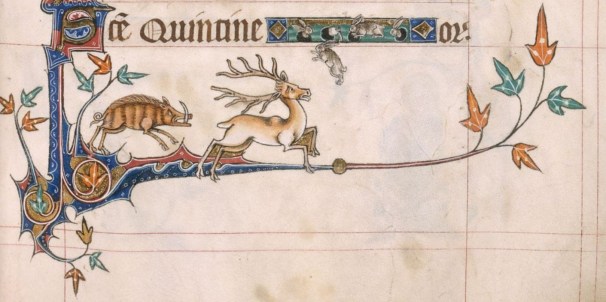
V&A

This semester–and yes, my life at mmbty-some years of age is still measured in semesters–has been the longest and the slowest that I can remember in some time. I am fairly certain that the trip that I was supposed to have made to London in early February was either:

  1. made in a different lifetime
  2. made in an alternate universe
  3. made by someone else who stole my identity for that trip and I now need to track the bugger down and get my life back.

In short, that jaunt to London was a flash of a visit, the delight and point of which has been pulled to the depths of my memory by the riptide of this semester’s duties. (That moment of verbal melodrama provided courtesy of an utterly shattered brain.)

Despite the complete void in my memory, my camera has photos on it that suggest that I did somehow make it to the good old Victoria & Albert during that blip, and pictures don’t lie. Well, my pictures don’t lie because I haven’t got the foggiest how to doctor them. I could probably sit them down on the sofa and mess with their minds, but properly doctor ’em? Nope.

Anyway, my camera tells me that (true to form) I spent a fair bit o’ time in the medieval rooms, and it appears that I was thinking about home furnishings and accessorizing. I suppose, there’s nothing like a tin-can of a hotel room to make you think about a spacious home. The tin-can I remember. Oh, and I believe there was a very happy interlude with a scone in the V&A cafe…. It all comes back eventually.


Ivory book covers. This year’s must have for that special person in your life who has everything… except a conscience.


Always make sure that when guests enter your house, they know where they stand: on your turf. Tile that foyer with your coat of arms as did John of Gaunt.

DSC01503

The arms of John of Gaunt and his wife Constance, 1372-89. Clear, coloured and flashed glass with paint. (from the collection of Horace Walpole, 1717-77)

Looking for a new backsplash?  Tile is so passé. Consider using Limoges plaques.  Nothing says “money to burn” like gilded copper with champlevé enamel. Anxious about looking excessive? Go for a spiritual theme like the resurrection to subtly suggest your mind is on higher things. Besides, don’t we all feel like this when the dishes are done?

DSC01501

Plaque with the Resurrection of the Dead, circa 1250. Limoges, France.

Have a hankering to decorate with a touch of the outré? Did you watch that scene with the clutching hand in Harry Potter and think to yourself, “Well, maybe if it weren’t so poorly manicured that would work on the Green Room’s mantle….” Then, for that soupçon of je ne sais quoi (ou pourquoi), try a reliquary. Let the neighbors show off their aquamanile collection. Nothing says, “I’ll see your lousy bronze lion water pot and raise you an even more priceless objet d’art!” like a reliquary. (Nearly all body parts represented in current market. Some disassembly may be required.)

DSC01529

Now empty reliquary from 1250-1300, Southern Netherlands.

Personally, I have to confess that I would collect aquamaniles in a heartbeat. So far as my shallow little heart is concerned, they beat reliquaries hands down. But then, I’ve never been into the outré and as for soupçons, I’m more a soupspoon girl. Speaking of which….

DSC01550 who wants a silver spoon when you can have

This baby from c. 1430 was clearly intended for display and not use. Netherlands, silver enamel, gilding and niello (black composition).

Have bare walls? Well, why not set off this year’s trendy, dark green walls with a set of ivory love scenes produced in Paris between 1300-1325? Aim the proper lighting toward them and they’ll not only frame themselves, but they’ll also set the tone.  We recommend scenes like these which are straight out of romance literature. Did we mention tone?


Lastly, a little personal accessorizing is always necessary. Why should one’s house be better appointed than oneself? (It shouldn’t.) I like my accessories with a touch (a soupçon even) of humor. Case in point: this molded leather number which is equal parts Dean Martin and the Prioress from The Canterbury Tales. Who could ask for anything amore?

DSC01553 equal parts Dean Martin and Wife of Bath

Moulded Italian leather bag, 15th century.

Well, I could. Of course, I could. The aquamanile collection at the Metropolitan Museum of Art for starters….

Frick

Aside from the morally questionable game of “If I could steal one thing” that I play in museums, I tend to go through them fantasizing about putting irreverent Post-It notes up hither and thither.  Knowing that museums tend to frown on that, I do not, of course, do it. Still, I think it would be a very interesting social experiment to see how people engaged with non-official, humorous commentary. Would they take them down in disgust? Post their own if they could in response? Methinks it would be an amusing experiment, but we shall, alas, never know.

Being in New York for a few days, I am doing the rounds of small museums built by American industrialists. Yesterday it was the Frick, today the Morgan Pierpont for the one and only U.S. stop for Tolkien: Maker of Middle Earth. So, before I head for the day, I thought I’d post the “Post-Its” that I couldn’t put up in the Frick.


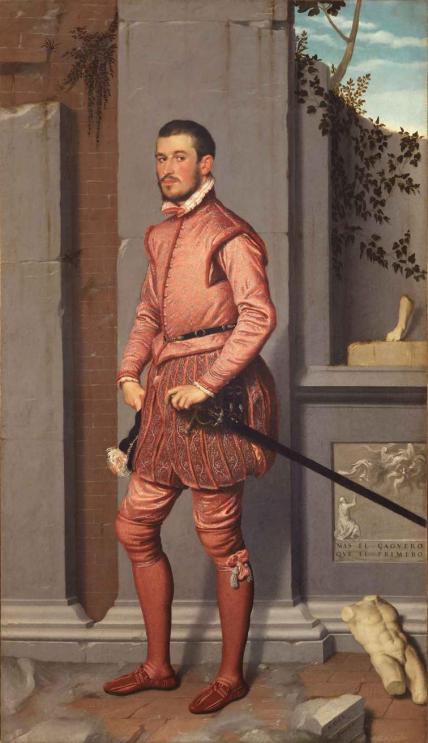
“Giovanni! Did you just knock another sculpture on the ground, young man? Basta! How many times do I have to tell you not to wear that esecrabile sword in the house!”


“Wait! I’m not ready. I just put a lozenge in my…. Oh, never mind.”


This spring, the fashion forward woman will be matching her hair to her feather. Ladies, this is de rigueur.


titian

Portrait of a Man in a Red Cap Titian (Italian, ca. 1488–1576) Date: ca. 1510


“Mama said this cap was a mistake,  but she was sooo wrong. (She also told me, I should shave my stubble and get a real haircut. The woman knows nothing.) My hat is no worse than that guy over there…”


“Are you talking to me? Are you seriously talking to me, you fop? My hat has points! Yes, fine. They’re soft points because it’s velvet, but it’s still a bloody serious hat. Yours looks like an undercooked pudding. Poltroon.”


“Points are for mustaches. Not hats. As for the pudding monstrosity, the less said the better. You’re both rather preposterous. Ask Mrs. Leyland over there.”


“Would you all just be quiet and let me contemplate the van Ruisdael? Peace and a fine prospect. That’s all I ask for.”


And now, if I could steal one thing….


On My Shelves: The Medieval Art of Swordsmanship

One of my favorite games to play in museums is: “If I could steal one thing….” It goes without saying that my friends who actually work in museums do not approve of this game (although I do manage on occasion to cajole them into joining in). It goes further without saying that I have never and would never do such a thing. It’s a game for focusing the senses.

The blame for this morally dubious pastime rests at the base of the pedestal of a fascinating astrolabe in the one of the Vatican Museums. Mmm hmm. Yup. That’s where it all started: an old astrolabe. If you’re thinking that’s an odd choice to make out of the entirety of the Vatican Museum, then all I have to say is, your imagination is free to purloin whatsoever it chooses.

Back in 2011 when visiting the Musée de Cluny-Musée national du Moyen Âge,  my “one thing” policy was seriously tested by their exhibition on the mythology and use of the sword. Finally, I narrowed it down to one manuscript illustrating combat techniques. Did I let myself get distracted by unique pommels? I did not. I’ll just take the manuscript, thank you. Did I fall for decorative incising down various handsome blades? Nope. Just the manuscript, please. In such cases, exhibition catalogues are generally how I reconcile myself to leaving things where they belong. So. the absolute non-existence of such a catalogue compounded my pain and agony a hundredfold. I had to make do with postcards and magnets of the manuscript. MAGNETS. There were not enough Sidecars in the whole of Paris to get me over that heartbreak.

Still nursing my disappointment (and perhaps a slight headache from those Sidecars), I made a pilgrimage to the Higgins Armory Museum in Worchester, MA upon my return, hoping to find solace in wandering the halls of armor, swords, pikestaffs, arquebuses, hauberks, and the like. While the displays included no manuscripts on sword fighting, in the gift shop I found The Medieval Art of Swordsmanship: a Facsimile and Translation of Europe’s Oldest Personal Combat Treatise, Royal Armouries MS.I.33.  I suspect that my calloohs, callays, and chortles of joy were matched by those of the clerk in the gift shop who rang up my purchases that day. My many, many book purchases.

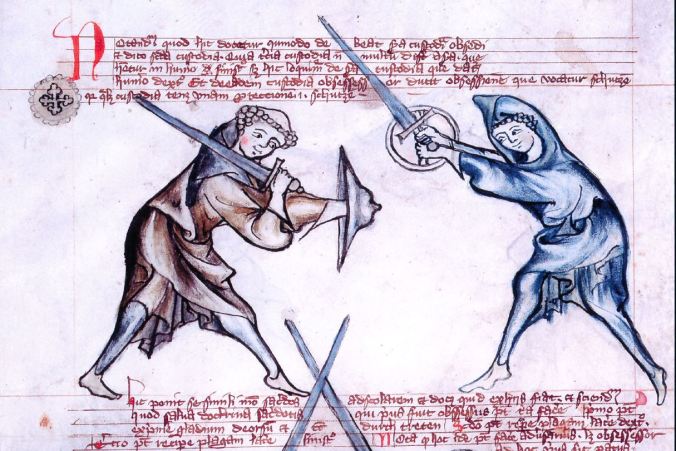
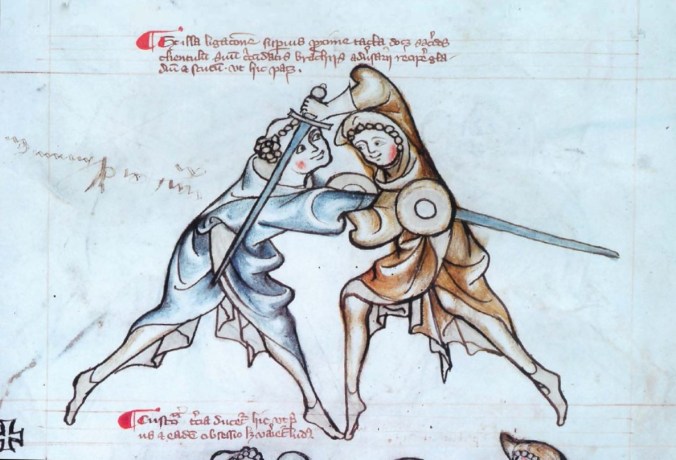
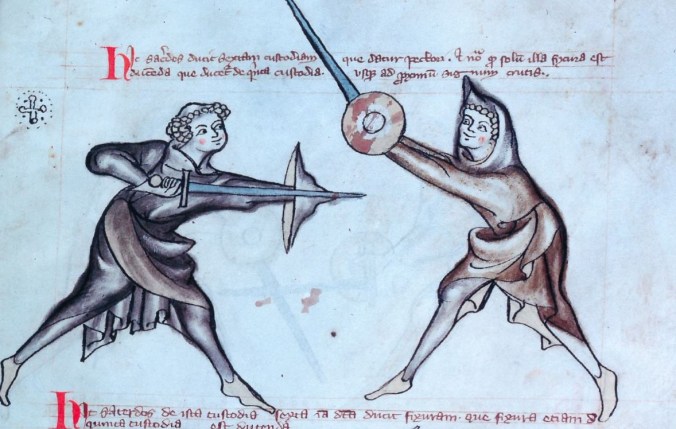
Within the pages of this particular gem are color facsimiles of a late 13th – early 14th-century manuscript on sword fighting wherein a priest in clerical robes (hood down) instructs a male student (hood up) and occasionally a woman, demonstrate a variety of offensive and defensive moves. While transcriber and translator Jeffrey Forgeng’s work is a serious work, worthy of the serious institution at which he and I did our doctorates (although at different times), I am entirely frivolous and will to leave it to readers to pick up the book (well worth it) and read the manuscript details (very interesting indeed) and textual details (cautionary).

Below I share only a few of my favorite “teaching moments”.

msi.332cp17cheeryfighers

Readers, Meet your guide to sword fighting instructor (the priest at left) and his exemplary pupil (right). No matter what move they demonstrate, those happy smiles never waver. (Royal Armouries, MS I.33, p. 17)

ms12c332cp24asphyxia

This is the “Asphyxia” move where you get in close enough to discover if your opponent remembered his deodorant that morning. Since this is the Middle Ages, be warned: he didn’t. (Royal Armouries, MS I.33, p. 24)

ms12c33iamnotleft-handed23

If you look carefully, the student (right) is doing an alternative, less showy version of the “I am not left-handed!” move made famous by Wesley in the Princess Bride. No really. (Royal Armouries, MS I.33, p. 23)

ms12c332cp33pool

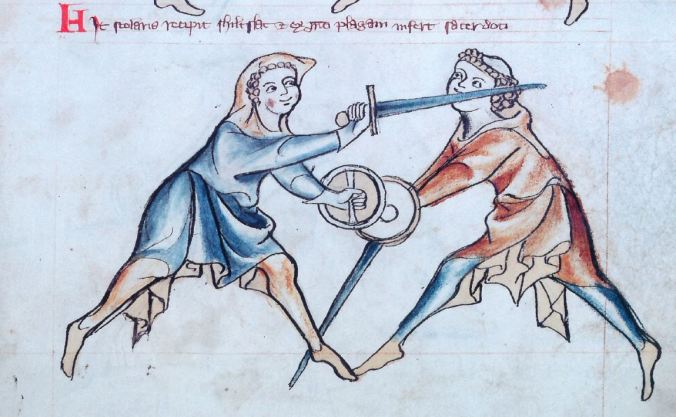
Here, the master is demonstrating how to take advantage of distractions like low-flying planes and skewer your opponent while he’s yelling, “De plane! De plane!” (Royal Armouries, MS I.33, p. 33)

msi2c332cp35noseparry

The deeply infantile “I’ve got your nose!” move that no one, NO ONE, finds amusing. (Royal Armouries, MS 1.33, p. 35)

MS I, 33 p 37 moves

The student is about to learn that Matrix moves do not work when dodging swords. Be warned. (Royal Armouries, I.33, p. 37)

msi2c33p57wondertwins

My absolute favorite move, and one which will go over the heads of younger readers: “Wonder Twin powers, ACTIVATE!” (Royal Armouries, MS I.33, p. 57)


P.S. The Higgins Armory is no more, at least not as a private institution. The collection was acquired by the Worchester Museum where it is well worth visiting.

Works Cited:  Jeffrey Forgeng, transcriber and translator, The Medieval Art of Swordsmanship: : a Facsimile and Translation of Europe’s Oldest Personal Combat Treatise, Royal Armouries MS.I.33. The Chivalry Bookshelf, CA, 2003.


Madness and other infelicities

Days like today make me feel like I bought my brains at a used car lot without digging  through the CARFAX listing carefully enough. Not nearly carefully enough.

I am currently prepping to teach a class on Middle English literature. Consequently, I’ve been happily submerging myself in scholarship that I haven’t touched for ages; lining my proverbial ducks in their tidy, proverbial little rows; and then steadily, albeit proverbially, shooting them dead. I was happily knocking off books when it happened. Let me emend that. It happened again, for the third time in as many days.

It started out perfectly normally. It is, after all, perfectly normal to come across a reference to medieval text or poem and think to oneself, “Self, that sounds interesting. Is that on our shelves?”[1]

“I think so,” answer I, toddling over to my burdened and benighted bookshelves.

img_2842(1)

one of the aforementioned burdened and benighted bookshelves.

In this particular and imperfectly normal instance, the work in question was Chaucer’s House of Fame which was heralded in the essay I was reading as including: “an abusive eagle,” a profusion of poetic wealth from centuries past that “overwhelms even the minimal level of human organization” (just like my bookshelves), and a “forest of rook’s nests” which are both “the nests of scavengers” and the “incubators of new life out of past in decay and putrefaction.”[2]

I was sold. Irony, the macabre, literary irreverence, and an abusive eagle. Who doesn’t want to read that? Of course, I should have read it before now (what kind of medievalist am I?!), but I assured myself that you can’t read everything. Better late than never and all that.

So, I levered the House of Fame off my shelves and opened it–just to bookmark it, mind you. I sure as heck don’t have time to read it now, but when the semester is over…. And that’s when it happened. AGAIN.  There on the page before me were the tiny markings of my own marginalia. It was unmistakably my writing. My writing is unmistakable.

img_2844At least, so I am told by the variety of people who feel an uncontrollable urge to comment upon it. Countless are the times that I have been told that my writing is illegible. It’s not illegible. It’s small. Alright. Fine! It’s tiny, but tiny ≠ illegible. This purported illegibility has been hammered home both gently (and un-) by everyone from examiners in grad school to my own sweet kith and kin. Adding insult to injury (FYI hammering hurts), my writing been compared to everything from Sanskrit to the tracks of panicked field mice. For my part, I do not consider it unreasonable to expect people to have magnifying glasses on hand. Preparation is half the battle in life.
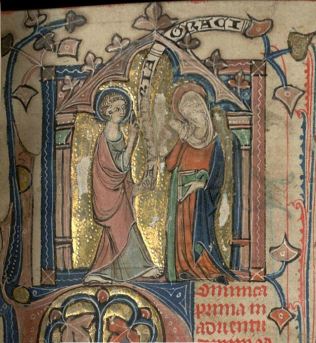
Besides, illegibility is not the point. The point is that I’d very clearly read the damned House of Fame before, thoroughly too by the looks of all my annotations, and yet I had no memory of it whatsoever.

Once? Okay, these things happen.

Twice? Really, Smith, this is a bit worrisome.

Thrice? Thrice in three days? Clearly, I am going mad.

Self, are we going mad?

Self: “You’re on your own, kid.”

Mad or senile. As I’m too young for either, both are equally discombobulating. Time shall, I suppose, tell all. In the meantime, I’m going to start shopping around for new brains, and I’m reading the fine print this time before putting my money down. I may be forgetful, but I’m good with fine print.


[1] Of course, I don’t speak to myself in the third person. First person is entirely sufficient. Just humor us. Me. I mean, me.

[2] Larry Scanlon, “Geoffrey Chaucer,” in The Cambridge Companion to Middle English Literature 1100-1500, ed. Larry Scanlon, Cambridge UP 2009, p. 165.

An Old English Advent Excerpt


Eala wifa wynn geond wuldres þrym,
fæmne freolicast ofer ealne foldan sceat
þæs þe æfre sundbuend secgan hyrdon,
arece us þæt geryne þæt þe of roderum cwom,
hu þu eacnunge æfre onfenge
bearnes þurh gebyrde, ond þone gebedscipe
æfter monwisan mod ne cuðes.
Ne we soðlice swylc ne gefrugnan
in ærdagum æfre gelimpan,
þæt ðu in sundurgiefe swylce befenge,
ne we þære wyrde wenan þurfon
toweard in tide. Huru treow in þe
weorðlicu wunade, nu þu wuldres þrym
bosme gebære, ond no gebrosnad wearð
85mægðhad se micla. Swa eal manna bearn
sorgum sawað, swa eft ripað,
cennað to cwealme. Cwæð sio eadge mæg
symle sigores full, sancta Maria:
“Hwæt is þeos wundrung þe ge wafiað,
90ond geomrende gehþum mænað,
sunu Solimę somod his dohtor?
Fricgað þurh fyrwet hu ic fæmnan had,
mund minne geheold, ond eac modor gewearð
mære meotudes suna. Forþan þæt monnum nis
cuð geryne, ac Crist onwrah
in Dauides dyrre mægan
þæt is Euan scyld eal forpynded,
wærgða aworpen, ond gewuldrad is
se heanra had. Hyht is onfangen
þæt nu bletsung mot bæm gemæne,
werum ond wifum, a to worulde forð
in þam uplican engla dreame
mid soðfæder symle wunian.” *


Normally, I would provide my own translation, but Christmas is today and all that, so I’m falling upon the grace of Professor Aaron Hofstetter’s translation below (to which I have made a few tweaks).

Hail, joy of women through the majesty of glory,
noblest of virgins across every corner of the earth
of which sea-dwelling men have ever heard spoken —
tell us the mysteries which came to you from the heavens;
how you ever took on your increasing, through the birth of a child,
never knowing any kind of union that the minds of men
would understand. Truly, we have never learned
of such a thing like this happening in the days gone by,
that you should take hold of this in your special grace,
nor need we look that event occurring any time ahead.

Indeed, that truth dwelt worthily within you,
now that you have borne that majesty of glory
within your breast, and your mighty virginity
was not corrupted. And as all children of men
have sown in their sorrows, so after shall they reap—
begetting as destruction.

So spoke the blessed maid, holy Mary
filled always with her victory:

“What is this miracle at which you all
stand amazed, and mourning grieve your cares,
O son of Salem and his daughter too?
Yearning, inquire how I kept my virgin state
and my trust and also became the mother
of the sublime Creator’s Son. For this is not
a mystery knowable by men, but Christ revealed
how in David’s dear kinswoman
the guilt of Eve is removed,
her curse cast down, and the lowly glorified.
Hope is received so that a blessing may abide
in both men and women together, now
and always for all time to come in the highest
delight of angels with the True Father.”**


Merry Christmas!

*Old English text from http://faculty.virginia.edu/OldEnglish/aspr/a3.1.html (Anglo-Saxon Poetic Records).

**A. Hofstetter’s translation of the entire cycle known as the Advent Lyrics (Christ A, B, C) can be found at https://anglosaxonpoetry.camden.rutgers.edu.


On My Shelves: La danse éliminatoire

Nestled on my shelves between a collection of Norse poetry and another collection of Ottoman Lyric sits a tiny–and I do mean tiny–little book. It’s so thin that sometimes amid the shoving and re-shelving it gets lost somewhere at the back, which is rather ironic given its subject.

Michael Ondaatje’s Elimination Dance, or for those with the Bilingual Traveller’s Edition, La danse éliminatoire, is a delightful oddity.  In 1991, well before the nightmares of Dancing with the Desperate or whatever is reality atrocity is current at the moment, Ondaatje published his collection of “eliminations.” The form of the collection (which is not really poetry) was inspired by the nature of eliminations dances (which I’d never heard of before) where seemingly random “eliminations” are called out and dancers retire accordingly. Ondaatje’s eliminations are clearly inspired by the generous folly of humanity. They are too oddly specific not to be based upon regrettable reality.

“Gentlemen who have placed a microphone beside a naked woman’s stomach after lunch and later, after slowing down the sound considerably, have sold these noises on the open market as whale songs.” (12)

It the bizarre specificity weren’t enough to convince one of the basis in real life, Ondaatje himself includes the following prefatory disclaimer “All original incidences which inspired the eliminations are the responsibility of the original persons.”

So, as much as anything, Elimination Dance is a catalogue of the stupidity that we humans can get up to, from “unintentially [locking] oneself in a sleeping bag in a camping goods store” (24) to  the dinner guest who has “consumed the host’s missing contact lens along with the dessert” (16). Think of it as the pre-qualifiers for the Darwin Awards.

I offer up a selection of my favorites.

q-tip

Those who, while visiting a foreign country, have lost the end of the Q-tip in their ear and have been unable to explain their problem (12-13)

I would have loved to have heard the original story that inspired this. I mean, how long is your ear canal that you lost your Q-tip in there? Does no one read the box? It clearly says, do not insert into ear.

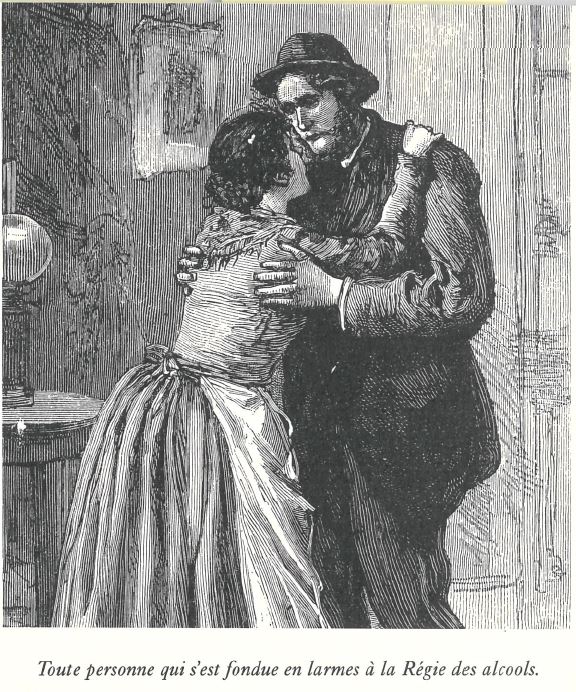
breaking down at the liquor board

Any person who has burst into tear at the Liquor Control Board. (41-42)

Now, admittedly those LCB taxes are high, but tears? Even I haven’t done that.

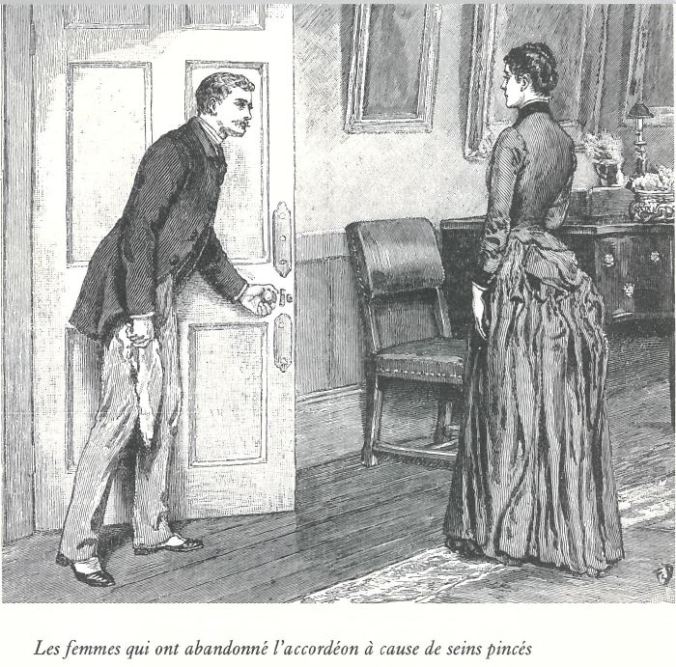
accordian pinch

Women who gave up the accordion because of pinched breasts. (28-29)

Some might say the unparalleled delights of the accordion are well worth a little pain. I’m not one of them.

And so they go. Ondaatje includes study questions at the end which beautifully spoof the questions included at the end of both book-club books and student textbooks alike. I cannot quote the best of them here in a “family-friendly” environment, but they are rich.

Several blank pages are left at the end of the book for readers to fill in their additions. The friend who gave it to me included two eliminations of his own:

“The excessively cheerful, particularly those who inflict themselves on others at breakfast.”

“All who drink decaffeinated coffee before noon.”

I have also added a few of my own over the years:

“Former majority whips of the House who go on TV dance shows.”

“Those who cannot live without the TV being on constantly.”

“Any one who upon receiving a scholarship has marched into the office of the granting body and announced that s/he should have been given more money.”

So, consider the dance floor full.  Eliminations may now be posted.


Michael Ondaatje, Elimination Dance/La danse éliminatoire, trans. Lola Lemire Tostevin, Brick Books, 1997

A Bouquet of Dragons

This post is for a young reader who shares my deep and abiding affection for the malicious and maladroit creature known as the dragon. There will be a forthcoming installment of Field Notes with a dragon. Since, however, that’s a few drawings down the line, I thought I’d offer up florilegium draconum, or…er… bouquet of dragons, from medieval manuscripts to hold over all those who want more dragons.

The medieval bestiary seems the most sensible place to begin, and one of my favorites is the Aberdeen Bestiary which is as good as Thanksgiving for the eyes. In the nature of bestiaries, the Aberdeen provides practical (in a manner of speaking) insight into the species.

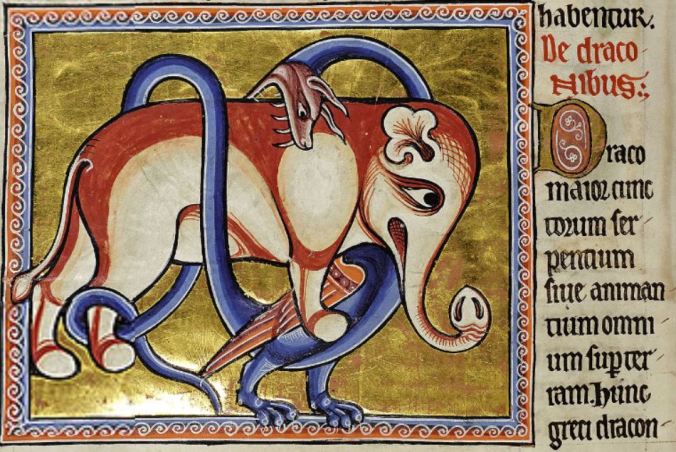
aberdeen 65 v dragon eating elephant

Aberdeen University Library, MS 24 f. 65v, c. 1200

Thus, we learn not only that dragons are the largest of both serpents and animals upon earth, but also that their emergence from the caves makes the ether tremble. If you ever wondered where dragons come from, they apparently originated in Ethiopia and India. Regrettably, the  bestiary does not say whether there is a distinction–as with elephants–between the Indian and the African species. Instead, the text provides instructive details like which end to be more afraid of, and perhaps that is more important than which branch of the family has the bigger ears. Fun fact for your next dragoning venture (like birding only far, far more perilous): a dragon’s strength lies in its tail not its teeth. (That seems rather contradicted by those fangs in the illumination but never mind.) Apparently, the strangling strength of those tails makes them fearsome threats to even great creatures like elephants. As with any good bestiary, the point is not natural history but spiritual illumination and so the text continues with an explication of how the devil is like the dragon. To be edified, go to the Aberdeen MS.

That connection between dragons and evil plays out in hagiography (writings on the lives of the saints) as well as in bestiaries. For example, dragon (demon) plays an important role in demonstrating St. Margaret’s authority and sanctity. In short, when our gal Margaret refuses to dally, marry, or have anything in any way tawdry to do with the pagan Olibrius, she is tortured not only by oily Olibrius, but also the devil.

In what can only be utter frustration at Margaret’s seeming immunity to temptation and torment alike, a demon appears in the form of a dragon and swallows her whole, thinking that’ll settle her hash. Unfortunately for the dragon, Margaret turns out to be as indigestible as she is invulnerable.  Lunch gets the better of the dragon-coming and going as we see here. (Of course, anyone could have told him that dress is way, way too much roughage.)

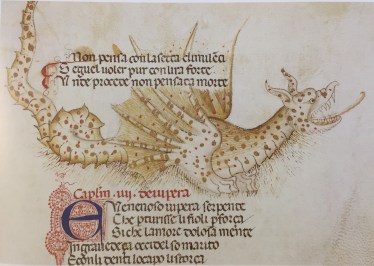
Returning to the earlier theme of natural history, we find this fellow in the Liber acerbe etatis from the second half of the 14th century. Personally, I do not believe that heresy was what got Florence, Biblioteca Medicea Laurenziana, Pluteo 40.52, f. 46rFrancesco Stabili, the composer of the Liber’s “encyclopedic [vernacular] poem dealing with the natural sciences, physics and religious philosophy” burnt at the stake (Imaginary Creatures, p 32). My money is on the dragon portrayed here hunting him down and crisping him for writing a poem that inspired such a spectacularly unflattering and spotty portrait.
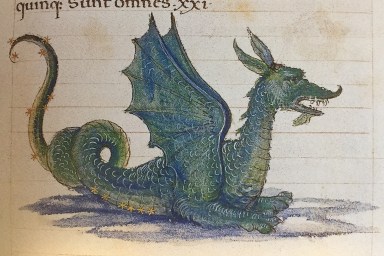
Florence, Biblioteca Medicea Laurenziana, Pluteo 89 superiore 43, f. 43r

Just to show how cosmically important dragons are, the next example comes from a manuscript that deals with astronomy. If you’re wondering what about those things that look like shuriken are all over the hindquarters of this dandy with a chin-beard are, wonder no more. They are not ninja weapons but stars. This particular section of the manuscript treats the constellation Cetus. While we today know this constellation as “the Whale,” it was better known to as a sea monster to the Greeks. Ergo, a starry-bummed dragon.

gorleson d is for dragon

If ever a dragon was cute as a button…. BL, Add MS 49622,  Gorleston Psalter 133v

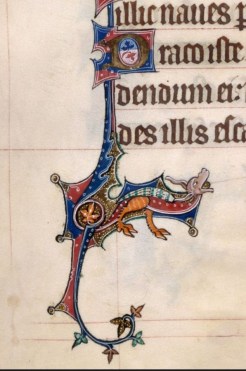
While bestiaries, natural histories, and astronomical miscellanies are all excellent places for finding representations dragons, some of the most delightful dragons–in my opinion–are the wholly decorative dragons one trips over in margins and lettering.

Admittedly, in real life, the only ones who think that dragons are decorative are dragons themselves, vain creatures that they are. Moreover the thought of tripping over an unexpected dragon should make anyone with any instinct for self-preservation watch their footing. In manuscripts, however, anything goes. So, a few dragons from medieval marginalia.

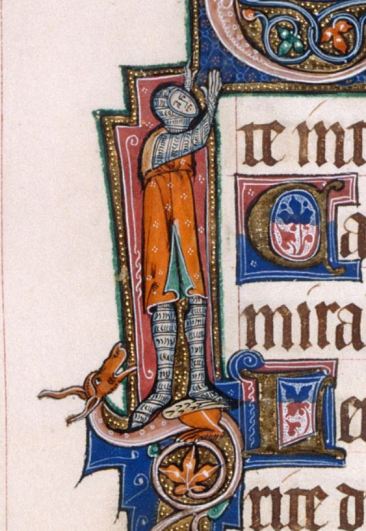
Another Gorleston Psalter beauty, which is worth going to the British Library site for in full, takes up the ubiquitous knight-dragon motif below. As with saints, knights generally get the better of dragons (as opposed to snails who tend to beat knights hollow. Go figure.)


Here, in an image which must deeply wound dragonly pride, the artist has reduced dragons to mere architectural filler. The upside for the beasts is that they can nod off, make lunch dates, or whatever while Merlin (on the left) drones on about the world’s longest prophecy to Vortigern.

No one will ever know.

Speaking of lunches, in this lovely marginalia from the late thirteenth-century Alphonso Psalter below, it’s hard to tell whether these two are sharing a salt lick or facing off. Whatever they are doing, I have to say this is one of the hodgepodgier dragons I’ve seen with his bird-like wings, ivy-leaf claws, stripes, and spots. It’s really no wonder it doesn’t know whether to kiss the stag or attack it. It’s probably having an identity crisis.

Some other post, I’ll devote attention to dragons in other manuscript traditions.

For now, I’ll just  pop in this crick-necked cutie. The late fifteenth-century manuscript from Northern Italy contains a collection of Minhagim (“religious customs”).  The illustrator has included this little fellow to spice up a passage treating with the seventh day of the Sukkot festival, Hoshanah Rabba.

We’ll wrap up in good, oxymoronic style with a selection of initials, specifically with a variety of zoomorphic capitals rather than inhabited capitals like the “D” with St. Margaret above.

This slideshow requires JavaScript.

This slideshow requires JavaScript.


Sources and Resources: Continue reading

On my shelves: The Babees Book

However much that title sounds like a board book introducing infants to bath time, numbers, or some such, The Babees Book in question is a collection of late Medieval and early Renaissance texts on manners, mores, courtesy, and edifying whatnot. I am drawn to courtesy manuals for their peculiar and particular representation of a period’s ideals. The tone of such manuals varies widely. Some are stridently (sometimes violently) moralizing, others benevolently instructive. Along the way, readers encounter authors driven by everything from cloying paternalism to disinterested superiority. Shifting through the wheat and the chaff of ideal and reality (I leave it to you to assign wheat and chaff as you see fit) makes for some interesting reading.

Aside from the two major texts of The Babees Book–different versions of The Boke of Nurture–editor Frederick J. Furnivall collects a florilegium of instructive little gems. Need to know how to prepare a serve a fest for a bryde? Look no further. Moreover, not only are the elements of the various courses laid out,you also find a sample welcome with which to greet guests.  Latin grace blessings, how-to’s on carving meat, and gems like William Vaughan’s Fifteen Directions to preserve Health (Directive 3. “Euacuate your selfe.”) and “Extracts about Fish” from The noble lyfe & natures of man.

Herein lies treasure trove of information you did not know that you needed until now. But wait–there’s more. There are footnotes.

Now, if you do not share my gleeful delight in footnotes, stay the course a moment longer. Admittedly there are any number of writers who have no idea how to wield a footnote properly. Yet, no reader can justly hold the footnote responsible for such clumsiness. That would be like holding the form of an essay responsible for an undergraduate’s inability to craft an interesting thesis statement. Like holding the concept of fermentation responsible for the pungent, reeking disaster that was my first attempted at fermented beets. Nevermind that. The joy of footnotes lies in their revelation of writers’ idiosyncrasies. Footnotes are the place for scholarly winks, nudges, jabs, and the buried reference to martinis in an otherwise entirely scholarly work on hagiography.

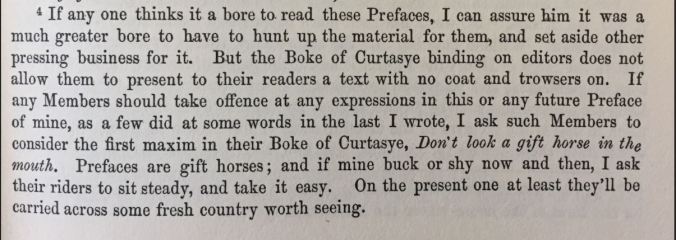
If you are one of the dubious, or worse yet one of those people who considers the bottom of the page the domain of page numbers alone (like an acquaintance of mine who reads neither prefaces nor footnotes), don’t listen to me.[1]  Listen to Mr. Furnivall, editor of The Babees Book.

boring prefaces

Furnivall, in4

I don’t know whether I’m more taken by Furnivall’s honesty about the grunt work of such details, or his wagging his finger at lazy readers who don’t sufficiently appreciate that grunt work. In any case, what coats and trowsers the precise Mr. Furnivall provides.

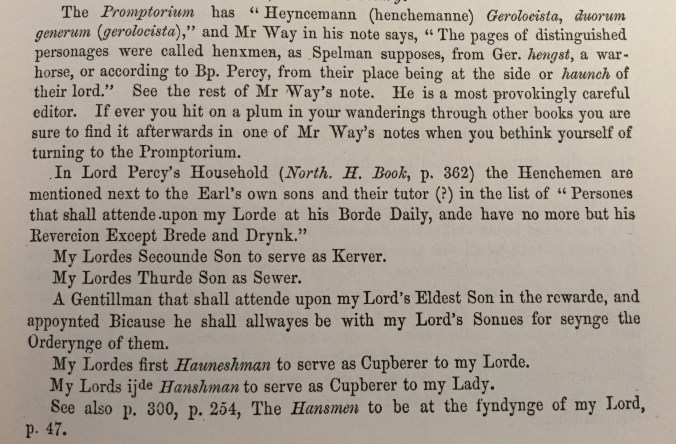
In discussing the behavior laid down for Henxman as dictated by the booke of urbanitie (who doesn’t want that book?), he adds an explanatory footnote for Henxman:

“Sir H. Nicholas, in his Glossary to his Privy Purse Expenses of Henry VIII…, says, “No word has been more commented upon than ‘Henchmen’ or Henxman.[2] Without entering into the controversy, it may be sufficient to state, that in the reign of Henry the Eighth  it meant the pages of honour.”[3]

If you’re like me, right now you’re thinking, “Wait! What? There’s an etymological controversy and you’re not going to share? SHARE!!!!” Be comforted, dear reader,[4] Mr. Furnivall is not so parsimonious with his information as is the aforementioned Sir Nicholas. The footnote continues with Furnivall’s own summation:

henchman

For those of you worried about the unfortunate thurde son, panic not. A sewer (or seuer/seuere) was the attendant who either performed the job of food taster or who carved for his lord. There was no sewage involved.

Setting aside the delights of henxman with all its variant spellings and the etymological implications thereof (and I do encourage you to check out the entries for hengest-man on the Middle English Compendium), look at Mr. Furnivall’s reference to Mr. Way: “He is a most provokingly careful editor. If ever you hit on a plum in your wanderings through other books you are sure to find it afterwards in one of Mr. Way’s notes when you bethink yourself of turning to the Promptorium.”

Reader, are you bethinking what I’m bethinking? Why do we no longer write in this manner? Who doesn’t want to go wandering through the Promptorium, hoping to hit upon a plum? Still, the lure of the Promptorium with its promised plums is ultimately not the point. In wandering through Furnivall’s comprehensively entitled The Babees Book: Aristotle’s A B C, Urbanitas, Stans Puer ad Mensam, The Lytille Childrenes Lytil Boke, The Bokes of Nurture of Hugh Rhodes and John Russell, Wynkyn de Worde’s Boke of Kervynge, The Booke of Demeanor, The Boke of Curtasye, Seager’s Schoole of Vertue, &c. &c., with some French & Latin Poems on like Subjects and some Forewords on Education in Early England, I have made a discovery: it is possible to fall in love with a man for his footnotes alone. Forget Jonathan Frantzen and his 10 tips for writers.[5]  Furnivall is the man to emulate. Any writer who combines devil-may care irony with detailed scholarship is worth his weight in EETS volumes;[6]

a few notes to fill the page

Furnivall, 113

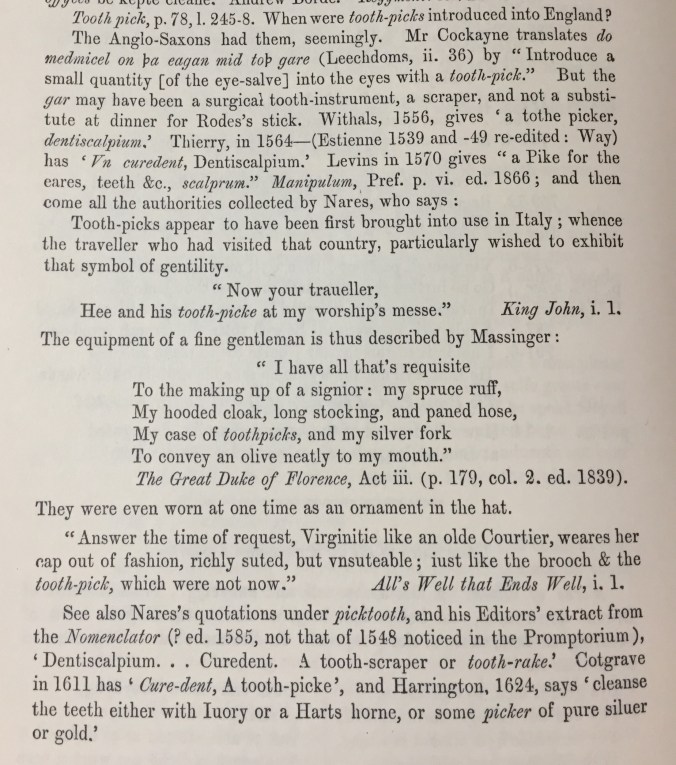
especially when one of those filler notes, rather randomly takes up the history of toothpicks, as follows:

toothpick

Furnivall, 114

Texts with trowsers on, plums, Promptoriums, and Toothpicks. Frederick J. Furnivall, I love you.


[1] If the preface in question is as whoppingly self-indulgent preface as Gayatri Spivak’s preface to Grammatology, a preface which feels nearly as long as Derrida’s book, I’m not going to throw stones at you for not reading it.

[2] Did you know that? I did not know that. Clearly, I’m having all the wrong water-cooler conversations!

[3] Furnivall, Frederick, ed., The Babees Book: Aristotle’s A B C, Urbanitas, Stans Puer ad Mensam, The Lytille Childrenes Lytil Boke, The Bokes of Nurture of Hugh Rhodes and John Russell, Wynkyn de Worde’s Boke of Kervynge, The Booke of Demeanor, The Boke of Curtasye, Seager’s Schoole of Vertue, &c. &c., with some French & Latin Poems on like Subjects and some Forewords on Education in Early England. [And yes, that is the complete title.] Greenwood Press, New York, 1969, iin2.

[4] Sorry, too much Jane Eyre. Just bear with me.

[5] No really, forget them. If this controversy means nothing to you, and you want to know, go here.

[6] EETS=Early English Text Society for those of you who don’t hoard up your pennies for these things.

In Praise of Groveling Wits

I’ve always taken umbrage at John Dryden for slandering puns as the ‘lowest and most groveling form of wit’. I was raised in a punning family. My father was an inveterate and unrepentant punster until life beat the humor out of him. He was the Speedy Gonzalez of puns, and I loved that about him. He wielded puns like a musketeer wields a rapier. Agile, quick, and deadly. My sisters and I would be left holding our wounds, groaning in pain around the picnic-cum-kitchen table while he’d chuckle gently. Every punster knows joy that comes from the infliction of deep, deep agony in one’s verbal victim. My father is still alive, but it’s been decades since I’ve heard a good/bad pun out of him. It was this transformation from impish punster to resigned parrot that, to me, served as the most painful indicator of his diminution. So, to our friend Dryden, I say, “Low? Low?!” I don’t even comprehend the connection of that word to wordplay. Pun. Pun loudly. Pun proudly, and let the gibes fall where they may.

Perhaps that is not entirely true. About puns being lowly, I mean. I did just have to apologize this evening to my flatmate this evening for referring to some game show disaster as a “vowel movement.” Around my friend’s agonized objections–“So bad! So bad!”–I heard the telltale thumping of my mother flipping in her grave. Over the years, my mum’s gotten a lot of exercise in there. A lot.

another boring hunt scene

Another boring hunt scene (BL Gorleston 210b – because I am totally obsessed with this manuscript)

It’s hardly surprising as I had her flipping in her grave before she died. I’d do something sub-standard that usually involved burping, and then she and I would do our little dance. By way of explanation, a super-nervous stomach meant I was basically a human eructor set as a child, and gas, so far as my mother was concerned, belonged ever and only in cars. Any hooo…. I’d belch, count to two, and like clockwork…

“Liesl Ruth! I despair of ever turning you into a young lady.”

To which ever-popular refrain, I would protest, “Oh Mom! I’m not that bad!”

Thereafter followed a sigh to wallop all sighs ever sighed. Desdemona breathing her last had nothing on my mother. Elinor exasperated by Marianne’s declaration of poetic love could not rival her. Little Amy Dorrit, lamenting for her foolish relatives, could only pale by comparison. My mother’s sigh was a masterpiece of controlled exhalation, discrete rather than maudlin, but replete with emotion. It suggested depths of emotion that even she would not admit to. The air echoed with a dozen different, unspoken failures. You could have built bridges with her sighs. Sometimes I did things just to get her to sigh that sigh. It was magnificent.

Maybe she was right. Maybe I was that bad.

Unlike my father, my mother did not pun, but neither did she roll her eyes or sneer at my father or diminish him for his sense of humor. For that, I am unspeakably grateful. I like having that memory of grace between them. I say grace, because there are a lot of people out there of the Dryden ilk who treat punsters like hardened sinners.  Après pun, their faces become as immobilized as an eighteenth-century death masks, and you know—you just know–they’re consigning you to some wholly inappropriate ring of purgatory for molesting their ears.  Why inappropriate, you ask? Because Dante did not create a ring for what other people consider bad wordplay. Not in the Purgatorio, not in the Inferno. Okay, he doesn’t celebrate us in Paradiso either, but that’s fair. So, take that, Dryden. Low, my sweet Aunt Fanny. No pun merits shaming. No, not even if you refer in awe to the giant baked potato on your plate as a potentator. No! Wipe that look off your face, reader. Not even then.

So, the rules of engagement for those who do not revel in “low” wordplay: Sneering? Not acceptable. Do not stretch and elongate your nostrils like some bactrian afraid of infection. Wit is not contagious. The more’s the pity.  Eye-rolling? Acceptable, so long as there’s a twinkle in that eye. Groaning? Perfectly acceptable. In fact, please groan. Loudly. We know that deep down beneath that groan is deep and abiding admiration and no small amount of jealousy that you didn’t get there first.

Strange Eulogies

Like most of us, I remember exactly where I was and I what I was doing on this day seventeen years ago. I was lecturing on Beowulf. Whether I was just introducing the poem or whether we had actually begun Grendel’s attack upon Heorot, I do not remember. What I do remember (to my shame) is giving the unknown student who interrupted my class a you’re-a-very-daring-person look before he informed me the university was closing because of attacks on New York City and that, as our building was located right behind the Massachusetts State House, we were to evacuate immediately.

Beyond a rather stunned injunction for everyone to be safe and leave campus immediately as directed, I do not remember a word I said to the class. The silence with which they vanished in a matter of seconds was memorable even if my words were not. Rather than fight the crowds on the abysmal Green Line, I wound my way down the oddly empty side streets of Beacon Hill to the Church of the Advent to give the madness of the subways an hour or two before going home. Where other people may have a memory of crowds and chaos, I have a memory of being alone and feeling oddly solitary on the city streets. There may have been people. There must have been people, but I remember feeling as if the city had been deserted.

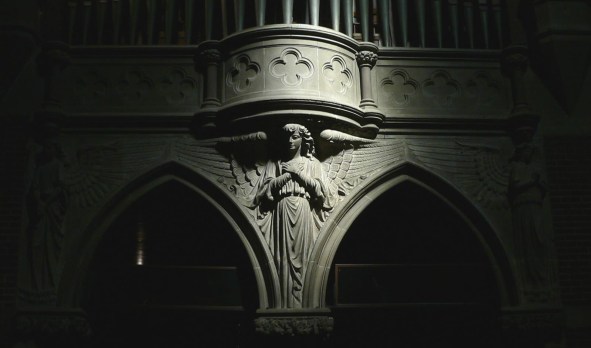
advent angel

Angel over the choir, Church of the Advent, Boston

For the next hour or so, I sat quietly mulling in the quiet of Church of the Advent. After asking the heavens what the world was coming to (and receiving no definitive answer), I alternated between reading Psalms from the bible in the pew in front of me and Beowulf I had with me in my satchel. Aside from the fact that there’s nothing like translation for clearing one’s head, life seemed a strange echo of art at that moment.

Item 1: A hall ruled by Hrothgar, king of the Danes; a hall in which the great men of their world boast and make plans; a hall in which these great men decide amongst themselves how their world shall go because they have the power to bend it to their wills and make it so.

Þa wæs Hroðgare      heresped gyfen,
wiges weorðmynd,      þæt him his winemagas
georne hyrdon,      oðð þæt seo geogoð geweox,
magodriht micel.      Him on mod bearn
þæt healreced      hatan wolde,
medoærn micel,      men gewyrcean
þonne yldo bearn      æfre gefrunon,
ond þær on innan      eall gedælan
geongum ond ealdum,      swylc him god sealde,
buton folcscare      ond feorum gumena.
Ða ic wide gefrægn      weorc gebannan
manigre mægþe      geond þisne middangeard,
folcstede frætwan…
healærna mæst;      scop him Heort naman
se þe his wordes geweald      wide hæfde.
He beot ne aleh,      beagas dælde,
sinc æt symle.      Sele hlifade,
heah ond horngeap. (ll. 64-82a)

Thereafter was fortune in war vouchsafed to Hrothgar, and glory in battle, that the vassals of his kindred hearkened willingly unto him and the numbers of his young warriors grew to a mighty company of men. Then it came into his heart that he would command men to fashion a hall and a mansion, a mightier house for their mead-drinking than the children of men had ever known, and there-within would he apportion all things to young and old such as God had granted him, save the people’s land and the lives of men.

Then have I heard that far and wide to many a kindred on this middle-earth was that work proclaimed, the adorning of that dwelling of men… the greatest of houses and halls. For it he devised the name Heorot, even he whose word far and wide was law. His vow he belied not, the rings he dealt and treasure at the feast. The hall towered high with horned gables wide…. (from J.R.R. Tolkien’s translation, Beowulf: A Translation and Commentary. Mariner Books; Reprint edition. 2015, p. 14)

Item 2: An outsider, a monster, uncivilized by the standards of these men, a son of Cain and thus cursed with all his kin; a creature to whom the sounds of rejoicing in the hall were torment.

Ða se ellengæst       earfoðlice
þrage geþolode,       se þe in þystrum bad,
þæt he dogora gehwam       dream gehyrde
hludne in healle;       þær wæs hearpan sweg,
swutol sang scopes.       Sægde se þe cuþe
frumsceaft fira       feorran reccan,
cwæð þæt se ælmihtiga       eorðan worhte,
wlitebeorhtne wang,       swa wæter bebugeð,
gesette sigehreþig       sunnan ond monan
leoman to leohte       landbuendum
ond gefrætwade       foldan sceatas
leomum ond leafum,       lif eac gesceop
cynna gehwylcum       þara ðe cwice hwyrfaþ. (ll. 86-98)

Then the fierce spirit that abode in darkness grievously endured a time of torment, in that day after day he heard the din of revelry echoing in the hall. There was the sound of harp and clear singing of the minstrel; there spake he that had knowledge to unfold from far-off days the beginning of men, telling how the Almighty wrought the earth, a vale of bright loveliness that the waters encircle; how triumphant He set the radiance of the sun and moon as light for the dwellers in the lands, and adorned the regions of the world with boughs and with leaves, life too he devised for every kind that moves and lives. (ibid, pp 15-16.)

There is, of course, much debate over Grendel’s malice and motivations.  Any number of readings turn the poem inside and out and on its head, and yet, while I resist as anachronistic and inauthentic readings that romanticize or excuse Grendel, the poem’s representation of the attack on Heorot requires that the dynamics of power and “civilization” be included in the analysis of this deep enmity.  Did Grendel chose the path of mearcstapa (l. 103. haunter of the marches/waste borderlands), or did rejection by men condemn him to occupy this precarious edge along society’s boundaries? How much (if any) responsibility do the men of Heorot bear for the ire of the creature that comes against them with a malice so determined that it seems to have been refined in fire?

I will not belabor the analogies, such as they are, to the modern context of the U.S. as a superpower. I will add only the confession that when we returned to class the next week, these were connections that I did not, for better or for worse, have the stomach or courage to make directly. The immediate aftermath of such a tragedy did not seem the place to do so. Now, the remembrance of those next classes is for me filled with a lingering sense of my own moral cowardice, as if I failed both the poem and my class.