Rome and Ancient Lactose Intolerance

Prefatory Apology: To my friend who works in cartography. You know who you are. You know, moreover, who I am and that there is no help for me. Mea culpa for what follows.[1]

Well, after the last two or three deeply earnest posts, I have wholly exhausted my shallow reserves of solemnity, and will now return to my modus operandi of chronic irreverence, quotidian frivolity, and ubiquitous piffle. I think I want that last on my tombstone:  L.R. Smith, purveyor of ubiquitous piffle.

It’s not even 7 a.m. and that’s the epitaph done. Methinks I’m in for a ripsnortingly productive day.

Speaking of ripsnorters, one of the maps that I never got around to discussing was an absolute monster of a map.  Although itself made in the Renaissance, the Peutinger was based upon a much earlier map which had served as a model for medieval mappæ mundi, or maps of the world. And what a world the Peutinger Map represents. It is essentially a road map of ancient Rome from the house of Pretorium Agrippinae in the upper left across eleven glued folia to”PIRATE” in the lower right of the last folio. It is both delightful in its beauty and impressive in its scope and implication.

If you go to the viewer here, you can scan through and get a sense of what a monster of a map it is. Excerpts like Figure 1, which shows the Mesopotamian Valley with its winding rivers and scattered cities, simply cannot do it justice.
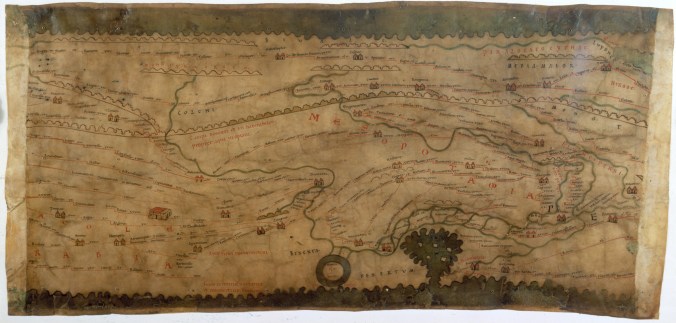
Peutinger's Beautiful Mesopotamian Valley

Figure 1. excerpt Peutinger Map. Hosted by Ancient World Mapping Center at UNC, Chapel Hill.

Thematic maps like the Peutinger with its road and cities contain hundreds of stories that are lost upon us unless we either know or take the time to hunt down the correct volume of Loeb and do due diligence matching up history with cartography. I’m going to save you the trip to the library with a gem, or perhaps cheese-curd, of forgotten history.

If one scrolls over the map toward the coast of North Africa, one finds Numidia (approximately where modern Algeria is today). This was the site of De Bello Iugurthino (The Jugurthine War) which took place between 111–105 BC when Jugurtha of Numidia took on Rome. We know of the story from Sallust (or Gaius Sallustius Crispus, born about 86 BC) who his version of the events sometime after 41 BC.
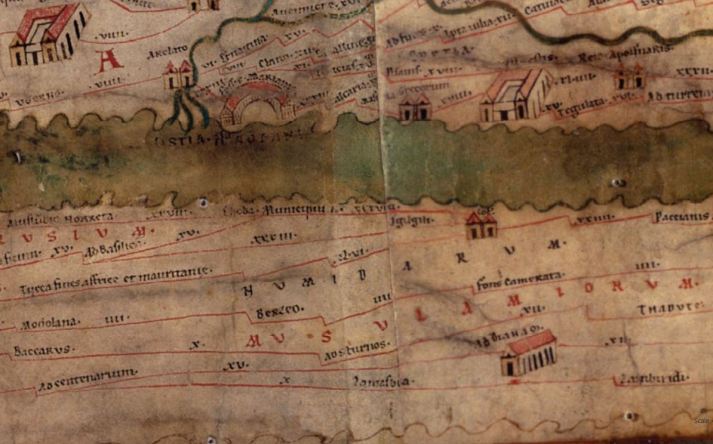
Numidia

Figure 2. Numidia

For those who don’t know, the Jugurthine War (Yogurt War) was the great dairy war of the Roman Empire. This was a trade war to caste the current U.S. president’s trade wars with various international economies (or personalities) into deepest shade. Really great. Tremendous even. Think back to the 2015-16 battles over milk pricing and quotas in the EU–because who among us didn’t follow that exercise bureaucratic folly with bated breath–then just let everything go really, really sour.

On the one side, there were the Romans who were promoting their new technology of bacteria and fermentation (Team Yogurt). On the other side, there were the Numidians who wanted to preserve their well-refined traditions of souring and coagulation (Team Curd) without some big bureaucratic power dictating processes or products. Since the Numidians were dealing with the Roman Empire which employed the most cutting-edge methods for international arbitration, the results were predictably messy. Essentially, the only folks that came out of this well were the early adopters of lactose intolerance who played Switzerland and stayed out of the whole mess.

Alright, this is a complete and utter fabrication. I feel the need to confess what is probably blindingly obvious because I once unwittingly misled a very earnest Harvard graduate student with a yarn about the private papers of the famous Bollandist Hippolyte Delehaye. Poor lamb. (The graduate student, that is. Delehaye could hold his own.) Perhaps I should have started by introducing myself as L.R. Smith,  purveyor of ubiquitous piffle.

A word to the curious or earnest:

If you really want to follow up and read the story, you can find it in Loeb vol. 116. With the exception of the Classicists among you, I don’t think you’ll find Sallust’s history isn’t nearly as interesting as mine.

To read more about the Peutinger:

  • Richard J. A. Talbert’s Rome’s World: The Peutinger Map Reconsidered , Cambridge UP, 2010.
  • Simon Hornblower, Anthony Spawforth, Esther Eidinow, Eds. The Oxford Companion to Classical Civilization, 2nd Ed. Oxford UP, 2014 See pp. 490-491.


The Demons of Indigestion

Two summers ago when I came across this little fellow on Chartres Cathedral I wondered if the stone carver hadn’t had one of those headless wonders called Blemmyes in mind when he carved this demon who is merrily providing a demonstration in infernal torture to the cathedral’s visitors.

Perhaps. Perhaps not. It may be nothing more than a case of the mason’s lunch not sitting well, or perhaps a colleague’s flatulence taking on a life of its own in the mason’s imagination.

Inspiration. It’s a mysterious thing.


On the Virtues of Maps, Maps, and More Maps. Pt. 1

I am not, I know, the only person to have vexed relationship with her GPS. Being sent to major highways for the “fastest route” when a local byway really would be more efficient is a ubiquitous GPS violation. Recently, however, my mobile’s GPS has started pranking me, sending me off unnecessary exits, and even changing the destination. Imagine Hansel and Gretel’s bag o’ crumbs starts laughing at them, “MWAH HAH HAH!” and snaking towards the wicked witch’s house. That’s my GPS.

Last week, on one of the few and excruciating occasions when I had to drive into Boston, a traffic snafu sent me digging around with one hand for the mobile, trying to get in the damn password, and speak in my destination, all the while dutifully swearing at and being sworn at by other drivers.[1] Within a few miles of hitting “GO,” my voice joined the choir of anguished souls screaming into the ether.

“Wait! NO! NO! NO! NO! NO! Not Rutherford Circle! Holy Saint Æthelthryth, how did I get here? How do I get out? Stupid GPS! I’m gonna diiiiiieeeeee!”

I leave the expletives to my readers’ rich and fertile imaginations.

Thus, I expect that it has always been, in sæcula sæculorum. Just as we curse the GPS on our mobiles, countless navigators over countless ages have undoubtedly cursed out cartographers or compass-makers.[2] Imagine the poor Viking who’d made holiday plans for Turks and Caicos only to find himself staring at the rocky coast of Newfoundland. [Please, read the following in a voice that is equal parts Yosemite Sam and the Swedish Chef.]

“If I ever get my hands on Cnut Redthumb, I’m gonna rip that laggard limb from limb! I knew I should have bought the map off of Harald Bluetooth.”

Of course, it goes without saying that anyone dumb enough to buy a map from Cnut Redthumb only has himself to blame: everyone who was anyone in medieval seafaring knew better than to trust Redthumb’s maps. [3]

When it comes to medieval maps, it is not so much a matter of all maps not being created equal, so much as maps being created for different purposes, which is not so different from maps today. I, for example, love caves and the maps thereof, like the map of Wind Cave National Park (Fig. 1) which adorns the wall by my desk. However usefully and beautifully it displays the multiple and intersecting layers of the cave system, were one to attempt navigating the surrounding upper world with it, one would roundly deserve to be trampled by any of the massive bison which inhabit that park. I am a firm believer in stupidity being its own reward.

This slideshow requires JavaScript.

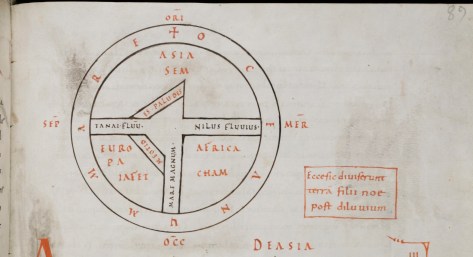
Many of the maps that populated the cartographic landscape of the middle ages require the adjustment of expectation. Where we have topographic maps and the like to help us better understand our physical geography, medievals had schematic alternatives like T-O maps which laid out their religious geography (see Fig. 2). When readers encountered maps where the waters of the Mediterranean, Nile, and Tanis formed a ‘T’ separating other parts of the known world like Africa, Asia, and Europe, they knew where they stood, so to speak. (It may help to notice in reading this map that East is uppermost.)

TO St Gall

Figure 2. St. Gallen, Stiftsbibliothek, Cod. Sang. 236, p. 89 – Isidorus, Etymologiarum liber XI- XX. 92nd century
http://www.e-codices.ch/en/csg/0236/89/0/Sequence-420

So, readers of Isidore’s Etymologiæ who came upon this map of the lands of Noah’s sons after the flood would never have dreamt of navigating physically with such a map. That wasn’t its point. Like all good T-O’s it provided readers with a rough schema of how the world they knew of related to the world of scripture and the history therein.

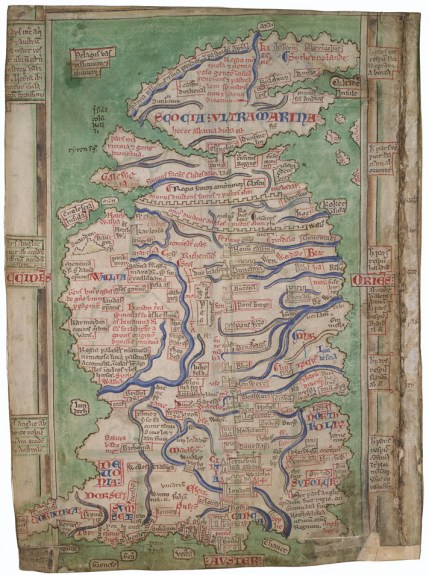
Where T-O maps are pretty sparse, other medieval maps present the world, or sections of it, in far more detail. Fig. 3 is by one of my favorite medieval English artists, the thirteenth-century Benedictine monk, Matthew Paris. I will sing Paris’ praises in another post. They deserve to be sung. For now, consider his map.

Matthew Paris Map

Figure 3. Matthew Paris’ Map of the British Isles. Cotton MS Claudius D. vi. f. 12 v. http://www.bl.uk/manuscripts/Viewer.aspx?ref=cotton_ms_claudius_d_vi!1_f012r

With its strongly delineated rivers and abundant cities, Paris’ map shows England as a beehive of development. Sure, you couldn’t find your way from A to B with it, but this map tells you that the journey would be worth it because there’s a lot to see at both points. Looking at this map, the rivers seem to pulse like veins through the heart of England, which, I suppose, is both truth and fancy. And I defy anyone not to be smitten by the way that Cornwall (or Cornubia in Latin) is trying to make a break for it across the Celtic Sea.

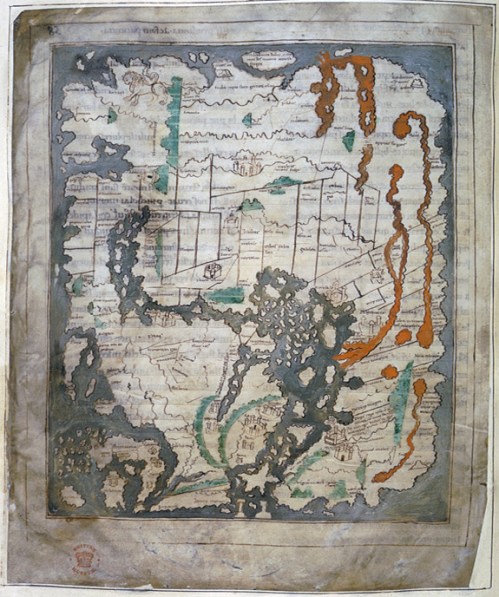
A contrasting English map (though not a map of England) shows just how different maps can. The Cotton Map (Fig. 4), was drawn in the eleventh century, some two hundred years before Paris drew up his. Like its more schematic T-O cousins, the Cotton map is oriented with the East on the top. The maker of the Cotton map provides more detail about what is important in the different parts of the world. If it’s not as generally accurate as Paris’ map, we can say that everything stays respectably within the borders. (If you’re looking for the British Isles, they’re in the bottom left.)

Throughout the Middle Ages, there are a variety of world maps such as the Cotton Map. On them, we find the traces of the delight medievals took in parts far-flung, in wild stories, and in the mythic histories of the wider world.

I’ll come back to those wild and wider stories in the next post with the mother of all mappæ mundi (maps of the world): the Hereford Cathedral Mappa Mundi. Where Cotton map’s is home to one solitary lion in the East, the Hereford is chock full of beasts natural and un-.


[1] In Boston, swearing is cosmologically as well as existentially necessary. If a Bostonian drives without swearing, it actually messes with the space-time continuum.

[2] We’ll completely leave out word-of-mouth directions like “Second star to the right and straight on ‘til morning.” I mean, what the dickens kind of directions are those? Forget the fact that “right” is relative based upon which way one faces. Forget, moreover, the fact that the stars dance around, so that second star to the right is going to be different in December than it is in July. Morning?! Are we talking break of day? Full dawn or perhaps full-on morning? This is the kind of directional negligence lawsuits are made of.

[3] This is a gross lie. I leave it to my readers whether the gross lie is a) the slander of Cnut; b) the existence of Cnut; c) the idea that any self-respecting Viking would content himself with talk of laggards and limb ripping; or d) all of the above.

A wider-ranging and decidedly less idiosyncratic take on medieval maps can be found on the British Library’s Maps and Views blog.

Of Tropes and Truth

I do not know how to tell my story without my mother being central to it despite the fact that I have lived over half my life without her. She died two days after I turned fifteen. In many ways, absence and loss have been the defining forces in my life, and while that sounds grim and negative, it has not been. At least not entirely so.

Fairy tales and the like sometimes incur criticism for the pervasive tropes of motherless children and wicked stepmothers because these so often pit woman against woman. When I write, however, I cannot escape narratives that reflect the shaping of identity against a motherless landscape, a landscape of mourning and absence. I have found absence a strange gift. Everything about it is Janus-faced. Absence creates space, room to grow without imposition, but also without guidance. One can wander out to explore a new horizon, but where does one look for the home light to find one’s way in the darkness? It is a wide horizon.

Loss forces one to work with the terrain of memory. Like a garden to which one returns after years away, crouching down in the dirt, one may find blossoms that had been loved, and yet long forgotten. All around those suddenly remembered loves bloom plants and flowers that one does not recognize, and the memory struggles to make sense of the juxtaposition. One touches the strange flower and wonders if it had been carefully planted by long-gone hands and forgotten, or merely blown in on a wind. One can weave a narrative to make sense of what one comes across, but doubt tickles the memory, and in this way, absence proves both fruitful and treacherous.

Liesl

apple

One Sunday afternoon a few years ago, I went to tinker at the piano. Weary of the stuff that litters my Mason & Hamlin upright, I went to the shelves which hold my mother’s music. Much of it has never been opened as my mother’s taste diverged from mine. Where she loved playing Liszt and Chopin, I have always gravitated towards Scriabin and 20th-century Russian composers. Different loves notwithstanding, I have kept her music, carrying it with me through many a move, all of it every piece of it with her elegant signature on the front cover. Almost at random, I picked Mendelssohn’s Lieder Ohne Worte (Songs without Words).

Shirley

tree

Aside from the loss of my mother who was a very fine musician, piano is intimately related to loss for me, on many levels. As a child, I allowed myself one dream: to be good enough to play chamber music with my sisters, one a violist, the other a cellist. By the time I was fourteen and getting good enough to mangle the Andante Cantabile movement of Schumann’s piano quartet in E flat major, any dream of chamber music with my sisters was dead. Indeed, my sisters’ dreams of music had been finished off by their own arms and hands steadily falling apart. One sister barely made it through her master’s recital, the other had to take off a semester off from conservatory.  In some ways, I was fortunate that my arm problems began at sixteen. I had no illusions. Indeed, it would be many, many years before I let myself indulge in a dream again.

Fast forward back to that Sunday afternoon, decades after all of this. I sat down with  Mendelssohn and began sight-reading. (Let the record show that I am a rubbish sight-reader. Noted? Good. We continue.) Now, some pieces of my mother’s music, I remember my mother playing. These are not among them, and from the style of her signature on the front cover, I think that she played this particular music when she was a younger woman, perhaps before I was born. Even so, as I played it was as if I heard my mother playing. In those pieces, I heard my mother’s “voice” more clearly than I had since her death, and so, I played for as long as my hands held out, unwilling to let go of that strange and beautiful conversation. It was not until the next day that I realized that the Sunday had been Mother’s Day.

I continue to work through the Lieder Ohne Worte for the conversations that I find there. Odd as it may sound, the practicing and interpretation of these pieces in poetry has allowed me to contemplate my mother as a woman and not just as my mother. Like a chord that does not resolve or a piece in an aching minor key, absence and loss offer up a strange gift that keeps one’s ear cocked for what may be as well as what might have been.

The following came from working on what is probably my favorite of all Mendelssohn’s Lieder.

Opus 67, No. 2

Search as I might the corners of my mind,
I find no trace of your voice,
for all the years I tuned my heart to its key.
Placidity, weariness, pain.
Straining across the silent years
I wonder what you heard in mine,
what you listened for.

We learn to speak as to walk, a rush
of testing syllables, a flurry of wobbling
words. Tongues do not catch fire.
Ours is no sudden gift, but a slow falling
into place whereby faltering tongue and whirling
thought lock and turn like gears
of muscle and joint, nerve and bone.

Syllable tumbles after syllable
propelled by sheer momentum.
We have monologues in tandem,
mistaking speech for conversation.
Only slowly do we learn to listen around
the words for the rise and rush of breath,
the varied shapes in a silence,
the color of some hesitation.

And so this last, strange modulation:
no longer the child storming to be heard
but a woman longing to listen,
I am left in silence wishing only that
woman to woman we might truly hear.
one another–whatever might be said.

Sort of the Middle Ages, or ‘When Characters Go Their Own Road’

If Clark Hall’s A Concise Anglo-Saxon Dictionary was to blame for my starting an alternate history for the Anglo Saxons after the entrance of William the Bastard, then Shakespeare is utterly to blame for screwing up my timeline. Blasted Bard. I am, however, getting ahead of myself.

My plan for the storyline for my books was neat and tidy. Alright, that’s rather misleading. It was sprawling but wholly medieval, and that–so far as I’m concerned–is better than neat and tidy any day. After all, who doesn’t love sprawling? Okay, some people, but not me. And medieval? I’ve got that covered like jam on bread. While I am far, far, far from knowing everything I’d like to, much less need to, about the Middle Ages (talk about sprawling), I do know how to research and find the needful. As I started the first book, drawing up maps and family trees as I went along, I came head to head with a product of my own imagination, and that’s when the problems started as I have, since childhood, lost every battle against my imagination.

Only having lived with my own, I don’t know how other people’s imaginations work. I’m sure I’m not unique in having an imagination that forces me to do things its way. This time, however, I decided would be different.

Everyone, I expect, remembers that silly scene in Sleeping Beauty where the fairies fight over the color of Aurora’s dress. Well, when I was small, that scene filled me with envy. Oh, not for the dress. I had no interest whatsoever in the dress. I wanted the wand, or rather a wand in the form of a less literal imagination. I wanted an imagination that would do what I wanted because mine was so desperately concrete. If I, for example, imagined myself in some fanciful costume (something à la Edmund Dulac whose illustrations I adored), I could never just re-imagine my dress into something else. Instead, I had to imagine myself actually taking off the dress and putting something else on. So, if I tried to mentally change the color of a dress—Red to gold. Red to gold—I could concentrate as hard as I liked. My imagination fought back.

“The dress is red, my girl, and red it shall stay. If you want a gold dress, then go to the closet and get yourself a gold one. This one’s not changing.”

My imagination could conjure a new closet. It probably would have conjured a vat of dye for me to dye the dress in the manner of Cassandra in I Capture the Castle, but allow me to simply transform it? No, and no again. Once created, the thing was its own, and my powers over it became extremely limited. To this day, I envy those doggone fairies, for I’m still the one who has to bend when coming up against my creations.

In fact, one of my relatively well-behaved characters forced me to change the chronology of my books entirely. I had planned on setting the first one, Liber Collisionum (A Book of Collisions), squarely in the Middle Ages, 15th century at the absolute latest. Then, Sebastian, who is not even the central character of that book, started quoting Shakespeare.

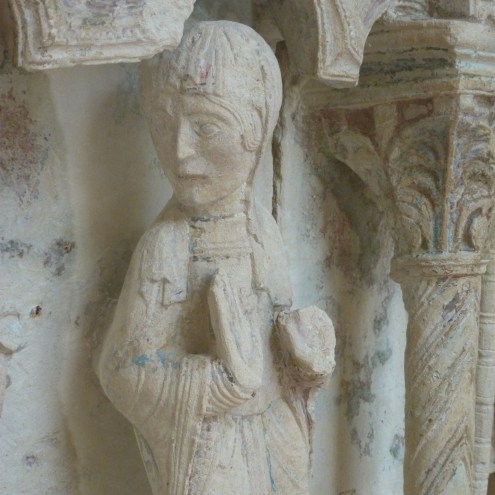
Talk to the hand Annunciation Louvres 12th cent

The original “Talk to the Hand” sign, from a 12th century Annunciation Scene (Louvres, Paris)

Did my character have the good manners to restrain himself?

To speak when spoken to?

To not quote anachronistic authors?

Did he not care that I’m a Medievalist, not an Early Modernist?

Do I need another rhetorical question to make the point?

He may not have been the central character of that book, but he was central to the relationships and plot, so I could not eliminate him. Well, I’m the writer and he’s my character, and I wasn’t about to realign my whole timeline to the Early Modern area just because one character had a penchant for Shakespeare. Early Modern is not my area. So, out came that Shakespeare. Only when I tried cutting out the Shakespeare, Sebastian fought back with the I’m-just-going-to-lie-here-on-the-page-and-see-how-you-like-it tactic. The boy might as well have said, “Vocavisti. Veni. Nunc erigis avem.” (“You called. I came. Now, I’m flipping you the bird.”) I could do nothing with him.

I did the only thing I could: I fiddled with space and time in order that Sebastian might return to his normal, insouciant self. Of course, by the end of that first book, his insouciance takes a real beating, but that regrettable circumstance is as unavoidable as the boy’s Shakespeare habit. We’ll see how he makes it through book two (of which he is the central character). Things are looking grim at the moment for him, poor lamb.

Rebellious characters, a fighting imagination, and fiddling about with space and time. Somebody’s got to do it.

On My Shelves: the fugitive and ubiquitous

I expect that for many people, libraries serve as a favorite ‘second home.’ For some, that home may be the tried and true library of one’s academic institution. For others, it will be the library that houses the particular book or item that is the current object of desire. [Scribal rant: For crying out loud Northshore Interlibrary Loan, you told me I was third in the queue for series one of The Good Place in January. January! It’s June!] And yes, dear reader, that momentary rant means that I do not “do” Netflix, Hulu, or any such. I’ll pay for books, but I will not pay for TV, and that brings us back to the subject at hand. Books, books, books, and the purchase thereof.

Being generally curious as well as thoroughly acquisitive where books are concerned, I have a fairly eclectic personal library. From books on the medieval and renaissance spice trade to guides on the flora and fauna of the Alps, from Ottoman poetry to the geology of caves, from books on the history of the peony to histories of typefaces, my natural profligacy is contained by two things alone: budget and space. I’m currently working on insulating my bedroom with floor-to-ceiling bookshelves. I’ll let everyone know how it works out next winter.

Some of my favorites books are catalogues from museum exhibitions.  The best catalogues distill a remarkable amount of scholarship about the objects’ or artists’ period and importance, and they do it with pictures! Or more correctly, for the pedants among you, plates. There are a few museums that I cannot seem to visit without leaving loaded down by new treasures (all legally acquired from the bookstore). The Musée de Cluny in Paris, for example, has dented my wallet repeatedly.  Another is the Cloisters in New York City.

Timothy B Husband’s catalogue The World in Play: Luxury Cards 1430-1540 from a 2-15-15 exhibition at the Cloisters is one such treasure from the Cloisters. Did I need a book examining the evolution of playing cards as the late middle ages slipped toward the early modern? Mmmm-yeeeees. When I purchased this catalogue, I was thinking it would give me the lay of the land regarding the style and production of cards of this time and maybe some of the games.

Style? Check.

Production methods? Check.

Games? Alack and alas, no.

Still, the catalogue more than made up for that infelicity. Perhaps this is common knowledge for others, but I did not know that playing cards (like so much else) were a legacy of cultural intersection from this age of exploration. They were introduced to the West, Husband writes, “about the middle of the fourteenth century, probably from the Near East via Venice or from the Mamluk sultanate in Egypt, through southern Italy, Sicily or even Spain” (p. 13). Since one of the foci of the novels upon which I’m working is the intersection of Christian West and Muslim East, I felt that little tidbit more than made up for the fact that, apparently, the games of the day are a mystery.

That mystery becomes apparent when one scans the richness and diversity of the few extant decks from the period. Admittedly, the variety of suits is not so important as their number, and there are consistently four.  Early variety gives way to certain norms. Where the French would eventually settle upon cups, batons, swords, and coins for their suits, the Germans had Acorns, Leaves, Hearts, and Bells, but that was the mid-fifteenth century.  Before that, you’ll get falcons, deer, hounds, and herons like the elegant bird below.

Scan 8.jpeg

1 of Herons, the Courtly Hunt Cards (fig. 37, p.39)

Of course, you and I will “get” nothing of the sort as such elegant, hand-painted cards as these have mostly gone the way of all things fragile and well used. As Husband writes, “Inevitably, cards are lost, torn, worn out, and the entire deck thrown out. Cards are fundamentally fugitive. But they are also ubiquitous” (ibid). The remains from that fugitive lot that Husband analyzes are certainly tantalizing. But where the suits can be made sense of, the multiplicity and variation of the face cards utterly confounds me. Where we today have limited face cards in our decks, the decks that Husband analyzes don’t stop at kings and queens, jacks and so on.  Take, for example, this potter who might be the inspiration for Demi Moore’s character in Ghost.

Scan 6

2 of Bohemia, the Courtly Household Cards (fig. 67a, p. 60)

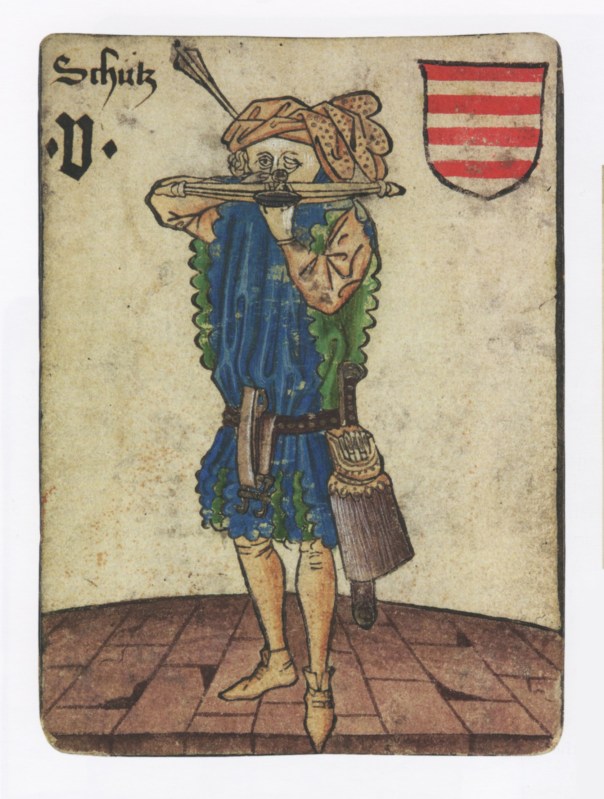
The suits of what is referred to as the Courtly Household cards are the countries of Germany, Hungary, Bohemia, and France. This sample from the colored woodblock prints is rather remarkable in its details. (The tile floor!) The above female potter is an example of one of the many functionaries who populate the deck in addition to the king and queen. Additionally, one finds ladies-in-waiting, marshals, chamberlains, chancellors, messengers, heralds, knights, crossbowmen (below), hunters, trumpeters, masters of the households, barbers, fishmongers, and fools. Maybe people who play complex card games can see their way through this and imagine possibilities, but as Canasta is the most complex thing I ever mastered (and promptly forgot), I’m stumped.

Scan 7

5 of Hungary, Crossbowman, the Courtly Household (fig. 76, p. 66)

Where the charming Courtly Household cards above, illustrate the various functionaries found within the world of the elites, a century later, we see another artist reflecting quite differently, even critically upon the world before him. The kings of the deck in particular reflect the reality of an expanding world, as with the King of Bells card below.

Scan 9

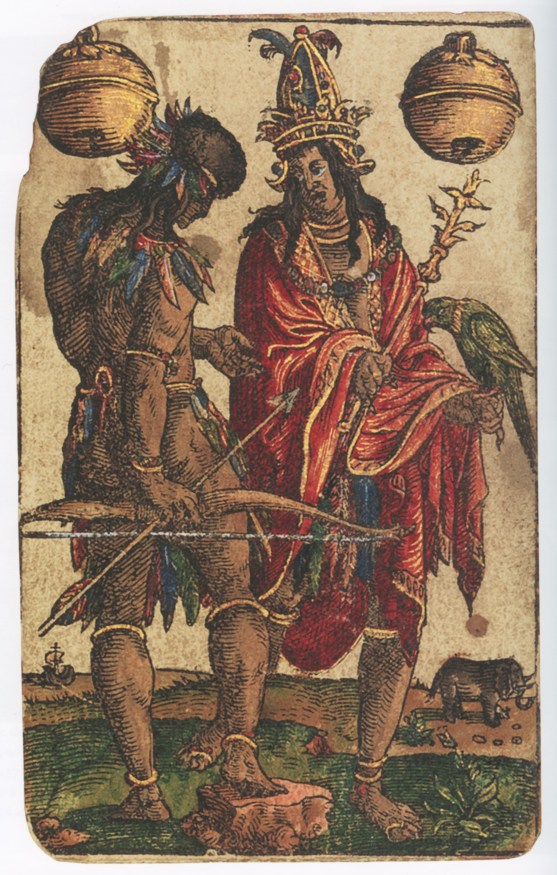
King of Bells, The playing cards of Peter Flötner (fig. 136, p. 106)

The kings of this deck by Peter Flötner are not solitary, posed men, but men of action. As with the non-European King of Bells who towers over the tiny (exotic) elephant and the instrument of exploration ship at his feet, the other kings tower over their landscapes. Another, dressed a bit like an Ottoman, raises his scepter over prone infants (looking, as Husband points out, uncomfortably like Herod surveying the slaughter of the innocents); yet another, this time very European king stands before a pikeman, clearly directing the actions of a great empire.

From the kings, the deck runs down the social scale. Yet, interestinly repulsive as an Under Knave with a conspicuously dripping nose may be, it’s the thematic representations on the pip cards that are the real innovation here. The acorn suit is bedecked with greedy boars; the leaf by peasants occupied variously; hearts by lovers in scenes from the tender to the profane; and bells by scenes of folly in all its various forms. In a move that joins together entertainment and commentary, the artist portrays what he saw and knew from a world stage where great men toyed with the lives of others to humbler scenes of courtship, from greedy consumption to the unmasking of deceit.

Now all I need is for someone to reproduce one of these decks and invent the games to go with it. Surely, that’s not asking too much.

Why the Middle Ages?

I am, of course, joking when I tell students that I lose all interest in English history after 1066. Of course, I am. Just as I am joking when I tell them that the last true king of England was slain at the Battle of Hastings and the rest have been bastards, imposters, and upstarts. There’s nothing like a refreshing dash of hyperbole to wake up one’s students, and hyperbole and I are friends of old. What I mean to tell students is that I lose interest with the Renaissance. Humanism. Rediscovery of Classical Antiquity. Scientific Advances. Perspective. Yadayadayada. While I don’t really mean that either (entirely), I do enjoy poking the bubbles of Renaissance devotees by discussing the various “renaissances” of the Middle Ages (seventh and twelfth centuries).

You throw down the Erasmus card, and I’ll play an Anselm or maybe a Maimonides.  You toss out a Piccolomini, and here’s Avicenna in your eye.

Dark Ages, my sweet Aunt Fanny.

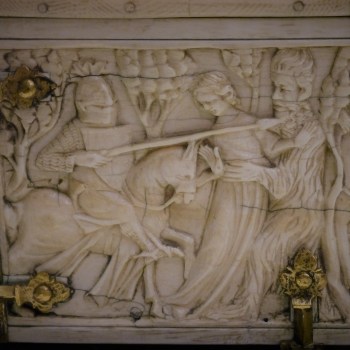
detail Ivory casket paris c 1300 musee de cluny

Detail, ivory casket, Paris c. 1300, Musée de Cluny

To spend the greater portion of one’s life reading medieval history and literature, much less in constructing several hundred years of history (complete with genealogies and maps) for a group of Anglo-Saxons who loathed the conquest of William the Bastard so much that they fled to the continent to re-establish a kingdom for themselves where no mercenary Normans could horn in obviously requires a deeper motivation than mere cantankerousness. Well, to steal a phrase from James Cambell’s reflection upon his early forays into Anglo-Saxon history, after my introduction to Old English in graduate school, “I have never looked forward since” (The Anglo-Saxon State, 269).

It isn’t that I don’t enjoy the literature of later ages. I do. Indeed, I return to Milton’s Paradise Lost again and again. I return to it in a way that I do not return to Beowulf. Eliot’s Middlemarch was a revelation to me when I reread it in my late twenties. Little Dorritt reduced me to gibbering envy for the way in which Dickens paints the opening pages. Using a vivid chiaroscuro, he sets the tone for the moral and political juxtapositions to follow in the next hundreds and hundreds (and hundreds) of pages. While there are occasions when the prosodic evils of serialization raise their head in Dickens’ many works, they do not do so–to my mind–in Little Dorrit. That is not to say there are not moments to make a feminist grind her teeth. (Gott in Himmel, why did the man so idealize self-sacrificing women?) Such infelicities notwithstanding, the first few pages of Little Dorrit wherein sun and shadow vie first over the harbor and then jostle, both literally and figuratively, behind the bars of a prison cell are masterful. I must read that book again.

And yes, before anyone points out the dates of those aforementioned works, I do make it up to the present day. If Kate Atkinson writes it, I will read it.

However strange this sounds, I think it is the sense of frontier that draws me to the Middle Ages. Like a wide horizon with the promise of something new, the Middle Ages offer the prospect of discovery. L. P. Hartley’s declaration that “The past is a foreign country. They do things differently there.” may be oft-quoted, but that makes it no less true. I find it a very valuable exercise to have to adjust my twenty-first century perspectives and expectations. Perhaps it is a human characteristic. Perhaps it is yet another piece of our collective inheritance from the Renaissance, but we tend to think of aesthetic, philosophical, and theological matters much like we do technical ones, as matters of progress wherein we are ever superior to those who preceded us.

Given that, there is something about the good, hard work of taking medieval events, developments, and people on their own terms that I find salutary. It is not about idealization of the past. (Give me a world with indoor plumbing and antiperspirants any day.) It is about the unmooring of my very time-bound expectations. As with any cross-cultural venture, the study of the Middle Ages never fails to give me new eyes for a present to which I am alternately insensible or despairing. It helps me to recognize my cultural convictions for what they are, to hold them a little less dogmatically, and to take myself a little less seriously.

It doesn’t stop me from being cantankerous. Don’t be ridiculous. That would take an act of God.

In My Travels

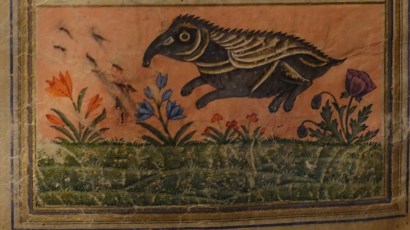
Last summer when I was in Dublin, the one and only place which I was determined to visit was the Chester Beatty Library,  Alfred Chester Beatty having been an American collector of everything from Chinese snuff bottles to Persian manuscripts.  Imagine having the pleasure–as Beatty once did–of being able to hold in your hands the History of the West Indies (Persian, 17th century) which contains the charming little anteater below. One can only assume that the little fellow’s Pepé-Le-Pew mode of perambulation is the result of a spicy meal of fire ants. In any case, he is a delight, and thanks to Beatty’s foresight and generosity, he frolics for the delight and happiness of all visitors to the CBL.

DSC00070 (2)

A frolicking anteater from a 17-century Persian manuscript, CBL T560, f41a

For the sake of conservation, as well as for the public’s benefit, some of the manuscripts, books, prints, and decorative items on display rotate through. I hadn’t researched what was on temporary last year, but I had planned the days with great care for what was open when and what was near what.  It was a grand schedule which went the way of all flesh because masterfully as I thought I’d planned, I had not accounted for the [expletive deleted] June Bank Holiday which fell upon the one and only day I had open for the CBL.

Reader, I wept.

Alright, I didn’t so much weep as gnash my teeth and cuss. Volubly and at great length.

Thus, when I returned to Dublin this year (with students), even though I only had two and a half hours to spare I got myself to the CBL the other day. There I did a quick round through their permanent exhibit on the book (which contained the happy anteater above) in order to focus the majority of my time on their temporary exhibit of the very fine Coëtivy Book of Hours (Parisian, 15med). This particular book of hours came into the Beatty collection as an anniversary gift from Edith Beatty to her husband. We should all receive such anniversary gifts. Or birthday gifts.

Christmas? May day? (My gosh, what does a gal have to do to get a fifteenth-century book of hours?)

Having babewyns and whatnot on the brain, I expect that I went through the Coëtivy exhibit rather differently from other people. I certainly went through it differently from the woman with a massive (and noisy) white SLR which intimidated the dickens out of me. While I fuddled about with my brand-new (wee) Sony, trying to figure out how to focus the damn thing on fine details (only to keep inexplicably turning on the video function), this woman clearly knew what to do with a sizeable camera. I must confess to a strange feeling of inadequacy that made me feel a sudden sympathy for men in public restrooms.

Still, if she knew how to use a camera, that woman knew diddly about looking. She shot the entirety of the exhibits and was out the door before I’d even finished looking at a half-dozen pages. Holy St Æðelþryð! Why not go all the way and strap on roller skates! When you’re in a museum, take the time to see things in context. Given how much thought, research, and design go into exhibits, I believe it’s worth stepping back (as well as stepping in) to receive and absorb. Look slowly. See newly. Just keep your nose off the glass.

Where was I before I went and got all homiletical? (No, it’s not a word, but it should be.) Ah, yes: staring at the margins of the Coëtivy book of hours and no doubt looking utterly daft. However lovely the central images of the pages might be, I tend to be captivated by margins and the decorative elements of medieval manuscripts; and those of the Coëtivy were exquisitely done (if a bit well-behaved for my taste). Below are a few, a very few, items from the margins.

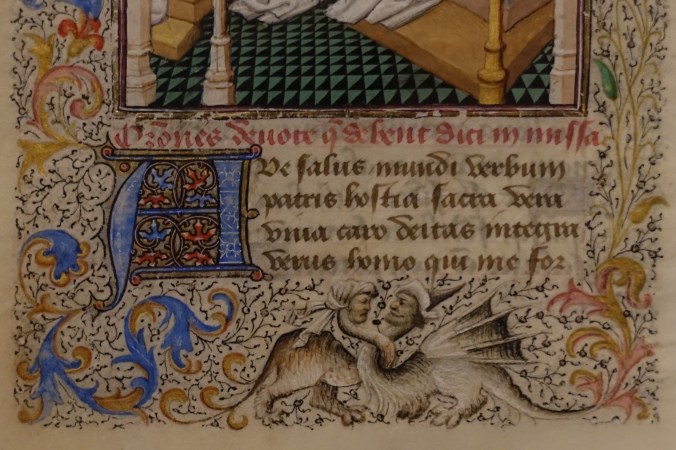
First, two tangled creatures from the margins of a page on (of all things) transubstantiation. Perhaps they are prophetic of the tangling of Catholics and Protestants over the subject in the years to follow.

DSC00112 (2)

CBL W 082 F.135v

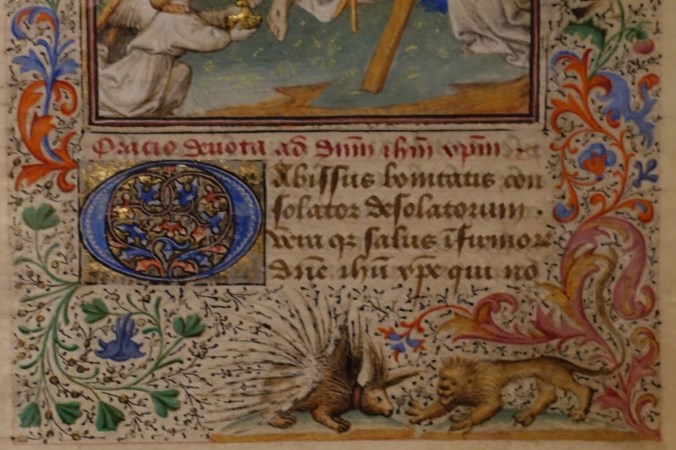
Second, don’t ask me to explain the fact that a porcupine and lion are facing off in the image below. I can’t. Since I couldn’t find any hedgehogs (which I love), you get a porcupine. Just because.

DSC00122 (2)

CBL W 082 .179r

Lastly, on the page displaying the martyrdom of St. James, I thought I’d found an example of the creature one sometimes finds with its face in its stomach. DSC00127 (2)Alas, no such luck. Closer inspection reveals it’s a cat cleaning itself. That is a sight which, frankly, never bears closer inspection. It beats me why the illuminator decided that the cat should clean itself while lounging on bellows. I could make up a story about bagpipes playing in the background as the illuminator worked and something about subconscious thoughts of squeezed cats, but I know I have at least one reader of Scottish descent who resents slighting references to bagpipes. So, I’ll leave that little mystery where it is and step away, simply commending the CBL to those of you planning a trip to Dublin.

Who Am I?

I suspect that every child is composed of contradictory bits and impulses, filled with unexpressed longings from which she shrinks for fear of disappointment. Few times in one’s life are, I think, as hard a childhood. It is a time when the desire for refuge is particularly keen. We long for few things as much as we long for a place to escape to;[1] a place to make sense of things, a place to feel as if we belong.

Refuge, of course, takes different forms for different people, but books have always been one of the most constant sources of refuge for me over the years, and that is only logical given the rate of bibliophilia in my household. Rarely did twenty-hours pass between the finishing of one book and the opening of another. We called bathroom “the Reading Room” because that was where we perpetually shut ourselves in, knowing that there one was guaranteed privacy.  (Our mother eventually became quite specific about what business she was referring to when she asked if we were finished.) We all did it–my sisters and I–particularly after dinner when there were dishes to be done. It wasn’t that we didn’t want to help. It wasn’t that we were lazy. It was that we were desperate to get back to our books. Desperate.

Books were the rockets that propelled me into new worlds, and I wanted a new world rather desperately. The real one had illness (a fair bit of it in my family), death, and non-suicide pacts. Loss is the normal stuff of life, and I reacted like most normal kids. I wanted out. Books (and music, but that’s another story) opened a less drastic door. From imagining myself in far off markets of Morocco listening to storytellers that I read about in Hoffman’s Mischief in Fez to the seriously bad behavior of Kipling’s Stalky and Co. which made a blessed mockery of my school misery, books offered freedom, escape, and perspective. The Psalms provided that salutary reminder that I was not alone in my misery while Sayer’s Gaudy Night held up a tapestry of possible futures and helped me envision other possibilities (and made me take a serious look at who I was letting myself become).cropped-reading-hedgie.jpg

It has actually never crossed my mind until this very moment, but storytelling was also something that we did in my family. For a few years there, my father made up stories with different characters for each of his three daughters. He was like Dickens (his favorite author) with nightly installments of new adventures. One of my sister’s stories were filled with talking animals, because she loved animals, but mine were always adventures of a father and a daughter. Together they navigated rattlesnakes, tricky mountain trails, and bears. They were comforting stories, stories that reality would belie, but still, I’m grateful for that familial touchstone.

My middle sister followed precociously in our father’s narrative footsteps. I remember our mother telling me how my sister’s teacher called home to report that my sister “told lies.” Apparently, my sister had been talking out the classroom window to the little black pony and yellow dog (or maybe yellow pony and black dog? )that went everywhere with her. They might have been invisible to the rest of the world, but they were real to her. When the teacher heard my sister talking out the window to her invisible duo, the woman would have none of it. I still remember my mother’s disgust when she told me that story years later.

“Stories are not lies. Anyone who doesn’t have the sense to recognize imagination for what it is has no business being a teacher.”

Rather than rebuking my sister for lying, our mother told her to be careful about making sure that her friends waited for her on the edge of school grounds.

This same storytelling sister and I shared a room and she would often greet me in the morning with the question,“Guess what I did last night!” She would then proceed to tell me of the adventures that Peter Pan had taken her on when he had picked her up at our unprepossessing suburban windowsill. They were marvelous stories of flying down waterfalls, riding leopards and other wild animals, and teaching the fairies a thing or two. After a while, however, I began to itch with a desire to go flying myself. I wanted to ride a leopard, and then, one morning I realized I could.

“Guess what I did last night?” I asked. And I was off.

[1] And yes, that is a preposition at the end of that there phrase. I reject the imposition of Latinate rules upon an originally Germanic language by the prescriptive grammarians of the eighteenth century. So there.