When I was in graduate school at University of Toronto, Trinity College’s annual Friends of the Library book sale was an event well worth the price of admission, and by admission I mean the nominal fee one had to pay to get in early on the first day. Some years were better than others depending on what one was hunting for. If the right person was downsizing their library, it was pure gold. One year, I nabbed both a volume I of the English Historical Documents (Whitelock) and the two-volume Shorter Oxford English Dictionary and the Shorter Cambridge Medieval Histories and and early edition of Stenton’s Anglo-Saxon England. No matter what the year, the EETS (Early English Text Society) volumes on offer never seemed to be what I needed, and I was not in a position to say, “Good Lord, a mere $30 for Richard Rolle’s Fire of Love? But of course!” It’s hard to justify building up one’s library of Middle English devotional literature if that is not one’s focus.
Much as I love used books, it is not unheard of for them to make my thoughts drift to hellfire and damnation. I once loaned a copy I had of a textbook to a student whom I knew to be in a tough financial spot. “Return it to me at the end of the semester,” I said, never imagining that I needed to include some gentle admonition that the use of vivid pink highlighter in someone else’s books was not the done thing. Who uses highlighter on someone else’s book, let alone their professor’s?! When the book was returned ruined and without apology, I consigned the textbook to the dumpster and the student to Terrace 2 of Purgatory with the indolent and unshriven. Then, there was the student to whom I loaned Frank Barlow’s wonderful book on the Godwins and that little wretch never returned it! I love Barlow. I love the Godwins. I loved that damn book. It’s a very, very, very good thing I could not remember to which student I loaned it because s/he would have been consigned (vengefully and immoderately) to the seventh ring of nether hell with the thieves. Admittedly those were my books, but the latter was “used” when the student decided to keep it and the former was most definitely used (and abused) when I got it back.
I am not a fan of errant ink in books neither my own nor other people’s. That is not to say that I am adverse to writing in books. The margins of my books are littered (a word that probably captures the true value of my comments and observations) with comments in pencil—fine, tiny pencil—that can be erased should I regret, or think better of a comment. The one exception to my “no ink” rule is in inscriptions. I love finding a used book with an interesting name and place and, if I’m lucky, date. Something about that little trio turns the proverbial tables. It is no longer the book coming into my possession, but rather that I am entering into the book’s history much as when one meets a new friend who naturally has a life that preexists your acquaintance. Something about that attendant past stays with me as I read, and I sometimes feel I enter a sort of conversation with a book’s past owners.
So, on the odd occasions when I pick up the ancient volume of Longfellow I inherited from my parents, I read with one “Mr. H. H. Kennedy” who clearly wrote with a dip pen and whose rather 19th-century style of handwriting suggests that he may have purchased the book for the $1.00 it cost when it was printed in 1882. Longfellow, I must admit, it not generally my tipple. I’m much more likely to spend an hour imbibing from one of the two volumes I have of Michael Drayton’s poetry, in which pursuit, “ROGERS” keeps me company. While there is no “Mr.” on the page to certify this assumption, there is something indefinably masculine about the confident surname smack dab in the center of the front page. Towards the bottom, city and date place the self-possessed Rogers in New York, February 1, 1954. I like to think of him sitting in Bryant Part to read Drayton after he’s spent a lovely morning in the Morgan Library & Museum studying Assyrian seals.
It is perhaps only right that a trilogy of saga-esque novels would have a more complicated history than volumes of poetry. My three volumes of Sigrid Undset’s Kristen Lavransdatter (Knopf 1946) each have two facing book plates from each of their previous owners. “EACH BOOK IS A NEW ADVENTURE” proclaims one bookplate which bears a picture of a knight charging out from the covers of a book. The bottom of the bookplate reads, “Ex Libris Marion G. Burns”.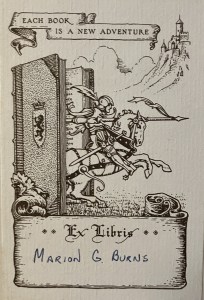 If the style of this first bookplate suggests a young reader, the handwriting does not. Marion wrote her name in clean, simply written large and small capitals. (I like the way she does her ‘A’.) It has style without being self-conscious. I think I would have liked Marion. The bookplate on the facing front page contains a picture of a ruinous Greek temple on a seaside cliff. “Mildred Knowles” in a handwriting with rather swooping (but not round) capitals. Under her name, Mildred conscientiously wrote “from Kathy – Christmas 1986”. Something about the second bookplate that makes me think that it is only Marion who reads with me; only Marion who thought deeply about Kristin’s life and experiences, and whose heart was wrung as mine is by these tales. I do not feel the same about Mildred. There’s just something about the self-consciousness of the bookplate of hers that niggles at me. Indeed, I wonder (without any justification whatsoever) if she even read the books. I likely do her a great injustice and have probably earned myself time in…. Oh, what ring do slanderers go to? Is it Purgatory or the Inferno? Bother.
More recently, I plunged over the metaphysical cliff in the wake of John Donne. My purchase of Metaphysical Lyrics & Poems of the Seventeenth Century: Donne to Butler (Oxford, 1952) came with a inscription in silvery blue ink: “R. M. Heckstall-Smith Sidney Sussex College Cambridge”. It actually took me a little while to make sense of the signature, but when I finally did, I kept thinking, “That name looks really quite familiar.”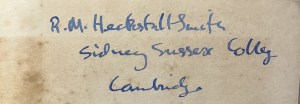 And so, while I do not usually google the names of my books’ previous owners, I did on this occasion. Now, when I pick up this book, I cannot help but smile at the thought of a young, undergraduate version of Dick Heckstall-Smith reading metaphysical poetry with me. Perhaps the young jazz saxophonist only bought the book for a course, but I like to think it was more than that. I like to think that he picked up our book every now and then over the years of an innovative career. Perhaps some poem by Vaughn or Donne provided a spark that required some musical expression from him. There’s no way of knowing, of course, but it’s lovely to think of the book spinning out worlds beyond itself and the words on the page shedding denotation and slipping into unbounded music.
“Valediction to Life”
Farewel ye guilded follies, pleasing troubles,
Farewel ye honour’d rags, ye glorious bubbles;
Fame’s but a hollow echo, gold pure clay,
Honour the darling but of one short day.
Beauty (th’eyes idol) but a damasked skin,
State but a golden prison, to live in
And torture free-born minds; imbroider’d trains
Meerly but Pageants proudly swelling vains,
And Blood ally’d to greatness, is a loane
Inherited, not purchas’d, nor our own.
Fame, Honour, Beauty, State, Train, Blood and Birth,
Are but the fading blossoms of the earth.
I would be great, but that the Sun doth still
Level his rayes against the rising hill;
I would be high, but see the proudest Oak
Most subject to the rending Thunder-stroke;
I would be rich, but see men too unkind
Dig in the bowels of the richest mine;
I would be wise, but that I often see
The Fox suspected, whilst the Ass goes free;
I would be fair, but see the fair and proud
Like the bright sun, oft setting in a cloud;
I would be poor, but know the humble grass
Still trampled on by each unworthy Asse;
Rich, hated; wise, suspected; scorn’d, if poor;
Great, fear’d; fair, tempted; hight, stil envied more;
I have wish’d all, but now I wish for neither,
Great, high, rich, wise, nor fair, poor I’ll be rather.
Would the World now adopt me for her heir,
Would beauties Queen entitle me the Fair,
Fame speak me Fortune’s Minion, could I vie
Angels with India, with a speaking eye
Command bare heads, bow’d knees, strike Justice dumb
As well as blind and lame, or give a tongue
To stones, by Epitaphs, be called great Master
In the loose rhimes of every Poetaster;
Could I be more than any man that lives,
Great, fair, rich, wise, all in Superlatives;
Yet I more freely would these gifts resign
Than ever fortune would have made them mine.
And hold one minute of this holy leasure,
Beyond the riches of this empty pleasure.
Welcom pure thoughts; welcom ye silent groves;
These guests, these Courts, my soul most dearly loves.
Now the wing’d people of the Skie shall sing
My cheerful Anthems to the gladsome spring:
A Pray’r-book, now, shall be my looking-glasse,
Wherein I will adore sweet vertues face.
Here dwell no hateful looks, no Pallas cares,
No broken vows dwell here, nor pale-faced fears,
Then here I’ll sit and sigh my hot loves folly,
And learn t’ affect an holy melancholy.
And if contentment be a stranger, then
I’ll nere look for it, but in heaven again.
Written by the notoriously prolific Ignoto, this poem has been (mis)attributed to Walton, but I’ve not read that authorship has been settled. Happy to be corrected. Reproduced from Metaphysical Lyrics & Poems of the Seventeenth Century: Donne to Butler, selected and edited by Herbert J.C. Grierson, Oxford: Clarendon Press, 1952, pp. 175-6.
 Trapped in the Scriptorium
I love used books, too, and for all the reasons you mention. Highlighting someone elseâs books!? Not returning them? Criminal!
LikeLike
Indeed! Maybe not a ring in the inferno, but definitely purgatory.
LikeLike